Tuesday, October 31, 2006

Symbol of the Six days of Creation

The following paragraph is from Dr. Asher Eder’s book The Star of David, which was published in 1987 in English in Jerusalem by Rubin Mass Ltd. The publication here is courtesy of Oren Mass
This chapter deals with the meaning of the triangles that constitute the Star of David. Photo is courtesy of "bibbjian" who published it on Flickr
I edited the photo in order to emphasize the Star of David which hides in the original, where six Roman emperors representing the days of the week surround Saturn who represents Saturday

Nature abounds with triads, as in sun, planets and moon; or in atoms, as protons, neutrons and electrons, or their three properties (mass, charge and spin) or states (solid, liquid and gas). The four elements - earth, air, fire and water - also ought to be mentioned here, insofar as fire is not in fact an element like the three others, but a process of energy exchange.
Within this context, it is worth noting that the Earth itself is endowed with the power to evolve, as we learn from its history, and as expressed in the Tanakh, or Hebrew Bible. There, the first two days of Genesis only the Creator is acting while everything created so far remained in its original primitive state, notwithstanding the built in possibilities of development. This state changed -certainly not accidental- at the third day when the Creator commissioned the earth to bring forth vegetation and fruit trees. Regarding the kingdom of plants, we read: "And God said: Let the earth bring forth vegetation...and the fruit tree..."; and with regard to the maritime kingdom: "Let the waters bring forth abundantly the moving creatures that have life"; and referring to the animal kingdom: "Let the earth bring forth the living creatures after its kind...". This marks the beginning of a however limited independence of created things. In man who was created on the sixth day (2 x 3!), this independence climaxed in the free will he can exercise to some degree.
When seeing the first three days of creation as symbolized by one triangle, and the second three days (days 4,5,6) by another triangle, their unity can be demonstrated by their harmonious joining in a hexagram. We recognize right away that its center, the hexagon as a consequential outcome of that creation symbolizes well the 7th day, the Shabbat. Indeed, Shabbat was not created: it is embedded in creation, marking its completion. We humans as being created on the 6th day are given into the laws of created nature. We are not “given into” the Shabbat, the 7th day; rather Shabbat is given to us: it is part of our human freedom to observe it, and “make it” (Exod. 31:16) into a part of our Divine freedom
This commission to evolve and develop is summed up in the words: "...[God] rested from all his work which "G o d c r e a t e d [i n o r d e r] t o d o ".
For the sake of clarity, let us reflect briefly on this well-known yet hardly understood phrase. It expresses so-to-speak two sides of one and the same coin. After the six days, or periodes, of creative work, God -speaking in human terms- rested from that work, looked at it, and found it "very good": the chaotic forces were given direction for a harmonious interplay; sun and moon were set for days, years, and seasons; the earth was commissioned to bring forth plants and living creatures; and man was created in his Maker's image. All this was created i n o r d e r t o d o , i.e. it was now upon man to subdue the earth and have dominion over it i n t h e i m a g e of the Creator, and live up to His likeness in accordance with the original plan, or blueprint, as outlined in Gen. 1:26 which says:
"Let us make Adam [=man] in our image as our likeness".
In this man-making process which goes on under the dictum "which he created to d o, God rested after all his work so that Man will complete it by his deeds. Right away after the above statement that God rested from all his work which he created so far, we read that He "breathed the breath of life" - the neshamah - into Adam's nostril s, providing thus the spiritual equipment for his task to "cultivate the Garden". Then He "planted a garden eastward in Eden"; formed Eve from his rib; rebuked Cain; saved Noah from the Flood; called forth Abram/Abraham; punished Egypt and took Israel out from there; gave the Decalogue; and on Moses’ request to “create” something new, did the earth open its mouth and swallowed Korah and his followers); etc.
All this occurred upon the earth which is, according to the Tanakh, as one of God's creations a dynamic power field subject to the eternal laws of the Creator.

Capernaum Convoluted Star of David

This picture was taken by Dr. Asher Eder about 40 years ago. He found out that it resembles another Star of David he saw in the ruins of an Herodian building in Beth-El, north of Ramallah. I heard from my teacher, Dr. Ze'ev Goldmann, who is an expert on religious symbols, that this is not a Star of David. It is an ancient Jewish symbol called tri-loop.

See an extensive article about
the Stars of David in Capernaum

Beith El - Defaced Star of David


This photo was taken by Dr. Asher Eder about 40 years ago in the ruins of an Herodian building in Beth-El, north of Ramallah. There, it had a curvilinear shape. When Dr. Eder wanted, a few years latter, to take a better photo he found out that the Star of David was defaced. Any how I heard from my teacher, Dr. Ze'ev Goldmann, who is an expert on religious symbols, that this is not a Star of David. It is an ancient Jewish symbol called tri-loop.


The following paragraph is from Dr. Asher Eder’s book The Star of David, which was published in 1987 in English in Jerusalem by Rubin Mass Ltd. The publication here is courtesy of Oren Mass
From the First Century B.C.E. on, we find [the hexagram] in the Land of Israel on many archeological sites.
Dating back to the second or third decade B.C.E., it could have be seen engraved on the ruins of an Herodian building in Beth-El, north of Ramallah. There, it had a curvilinear shape, similar to that of another star found in the ruins of a second-century C.E. synagogue in Kfar Nahum (Capernaum): The Beth-El hexagram was recently defaced.
In the ruins of Kfar Nahum, we can still see another example of the star, one designed with straight lines, composed of two equilateral, symmetrically interwoven triangles.

Monday, October 30, 2006

The Circle and the Star of David

Circle and the Star of David
The following paragraph is from Dr. Asher Eder’s book The Star of David, which was published in 1987 in English in Jerusalem by Rubin Mass Ltd. The publication here is courtesy of Oren Mass
This is not an arbitrary exercise. It is indeed geometry which gives us a clue to this understanding. When we draw a circle and apply its radius to its circumference, we will find out that it fits exactly six times into it. Connecting the six centers of theirs, we get either a hexagon, or a hexagram.

As known, it is impossible to exactly square the circle (notwithstanding the value of pi = 3,14 which suffices in our daily needs to bring us near to this equation). In contrast, the above figures show the only possible direct relation between a circular and a cornered area. That means to say that the triangle as the most basic geometric unit with distinct corners can evolve directly from the circle which may represent infinity and harmony.

Creator -Creation

Creator -Creation Magen David


The following paragraph is from Dr. Asher Eder’s book The Star of David, which was published in 1987 in English in Jerusalem by Rubin Mass Ltd. The publication here is courtesy of Oren Mass.
Let us consider the six-pointed star as consisting of two equilateral triangles. The triangle is the simplest conceivable plane figure with distinct points. While in mysticism the number four and the square represent the created world, the number three and the triangle represent the various possibilities resulting from the division of the One into two. The One Creator brought about these possibilities by the very act of Creation.
If, for the sake of argument, we depict the Creator and the Creation each by a dot, then the line connecting these dots denotes the relationship between them, the relationship between "above" and "below":

Indeed, the creative power is purposefully directed, and manifests itself in forms. As life needs form in order to express itself, so does the primordial creative power (,אל el) act, and appear, as Creator (elohim) in Creation. Creation is not an act which was performed only once in the distant past, but is rather a continuous and perpetual process - "God renews the work of Creation every day", say our sages. Interestingly enough, the Hebrew word for Creation, briah, conveys this idea. Its end character (heh), as in any other words written with it, indicates an inclination or movement towards something. And modern scientists admit:"... the stability of matter is a pure miracle when considered from the standpoint of classical physics." It is this constant renewal which sustains life and causes the appearance of new forms, adding a horizontal, "expanding" aspect to Creation. When we become aware that a continuous act of Creation brings into being new entities which continually evolve, we can visualize the number three emerging from the line connecting dots One and Two.
Since these continual changes occur only within the framework of laws established for the world, we, being subject to these laws, cannot draw the third dot as an extension of the line connecting dot One to dot Two. Rather, by setting it beside these dots, we form a triangle in which each point represents an aspect as it relates to two other aspects of a certain force. We draw the triangle with both sides of equal length in order to express the harmony between these different aspects...
In our context, the triangle may be seen as the symbol of a power field, while two triangles, as in a hexagram, represent two related power fields. The two primordial power fields would, then, be the creative force of the creator symbolized by one of the two triangles, while the creation and the forces invested in it would be marked by the second triangle. The interlacing of the triangles, then, indicates that Creator and creation cannot be separated; one can't be without the other. They are a unit: One.

The Kabbalistic "Tree of Life"

The following paragraph is from Dr. Asher Eder’s book The Star of David, which was published in 1987 in English in Jerusalem by Rubin Mass Ltd. The publication here is courtesy of Oren Mass
The harmonious balance of a relationship as indicated by the Star of David is possible only if the two partners are balanced in themselves. Contrary to widespread view, harmony is not achieved by merely coming together and joining.
When we examine the two triangles of the star, we may visualize a central point for each of them. If the centers are not congruent, the star would be distorted, off kilter.
What is the central point? Could such a point in an individual ever be congruent with that of another person?
Human beings are so different from each other that, among the billions who inhabit the globe, no two people are endowed with exactly the same faces, fingerprints, or voices. Everyone has a personality of his own, so much so that the sages say: "Whoever saves a human life has saved a whole world; and whoever destroys a human life has destroyed a whole world."
Yet, behind these countless outward forms is something higher. In fact, the "higher" we go the more closely we approach this unifying point which, in modern terms, is sometimes called the Higher Self; or archetype of man. The Torah, much more to the point, speaks of it as the Adam Kadmon, the human being created in God's image. Following the Torah, we may see the Higher Self as a sephirah open to Man below and to the influx from above. It can be compared to a center which maintains the balance between our earthly nature and the Divine, as well as between our right and left, and all that is symbolized by these terms. As descendants of Adam, we all share in it. It enables us to know ourselves, to know and love one another, and to realize our common humanity.
The Jewish Kabbalah expresses these principles in a diagram known as the Tree of Life.

It shows the "absolute" polarity of Crown (keter, creative power) and Kingdom ( malkuth, material world) as well as the relative polarities in its right and left pillars (force-form; positive-negative; male-female; give-receive). These polarities are brought about and governed by the sephirah Crown.
The ten sephirot of the Tree of Life are connected by lines ("paths") which form different triangles (power fields), each with its own significance and falling between Crown and Kingdom.
This indicates that:
a) All comes from the One, divides into the Two and multiples, and then reunites into One;
b) The Tree is harmonious and balanced if and when all the triangles showing its different functions are in their proper place and shape;
c) The whole essence of Judaism is included in the names Crown for the uppermost and Kingdom for the lowest sephirah. The name Kingdom, if applied to the mineral, vegetable and animal worlds, implies that the material world is not separate from God, but is rather his "footstool". When applied to Man's world, the name Kingdom prompts us to acknowledge His sovereignty over all Creation, and to be aware that the world has been entrusted to our care, that we may raise it to the level of the Divine and have dominion over it, in the image of the Creator. By doing so, we indeed put the Crown upon Him to whom it belongs, and make the Earth His Kingdom. This is exemplified by King David, who is the corresponding figure of the sephirah malkuth (Kingdom).
Man, although formed from the dust of the earth, is modeled in the image of the Creator. This is indicated by the lower rhomb of the Tree, shaped exactly like the upper rhomb (the partzuf, or face).
Part of the lower rhomb - the triangle of Kingdom-Endurance-Reverberation - marks the state into which we are born (ego incarnate). As man is not intended to remain in this state, he naturally follows his inborn inclination to "go higher", to grow professionally, intellectually and spiritually, aspiring towards ever-loftier goals. But ultimately, all of us must realize that this subjective urge "to go higher" is actually rooted in our inherent longing for objective and Absolute Truth which is always above us, symbolized in our graph by Crown. Crown "calls" us constantly through what we sense as our innermost voice. It calls for our teshuvah, this Hebrew word meaning both answer and repentance. It asks us God's eternal question to Adam - "Where are you?" - and calls us to go beyond the barriers marked by Endurance-Reverberation and unite in Splendor with the Divine, marked by Crown.
This process is often described as a spiritual rebirth which, while leaving all the functions symbolized by the lower rhomb intact, provides new vistas and opens us to Divine guidance. The sephirah Splendor, besides its intrinsic value, forms the hinge to the upper rhomb. In this way, we can say in the words of Ps. 25:1: "To Thee, O Lord, do I lift up my soul".
However, in Jewish teaching, it is not enough to "go higher" in feelings alone. Going higher merely in accordance with our own ideas and ideals may in the beginning produce fine effects but in the end would result in the Confusion of Babel. Our progress must be reflected by actions in accordance with Divine Instruction from on high, from Mount Sinai. Indeed, the Torah tells us right in the beginning that God "rested from all his work which he created to do." (See note 8 of Chapter 3.) In this context, we may appreciate that the Kingdom of God; Shabbath; holiness; etc., were not created, and hence not imposed on our nature; we rather must stride towards them, and thus "make (=do)" them. The Torah stresses this repeatedly. For instance, concerning the Shabbath, we read that "the Children of Israel shall keep the Shabbath [in order] to make the Shabbath throughout the generations."
All our doings and makings, whether "sacred" or "profane", occur in the sephirah Kingdom of our Kabbalistic Tree of Life. By doing what we are commanded to do, we come to understand their intrinsic value and beauty. "We will do, and we will hear"; and "the fear of the Lord is the beginning of wisdom."
Thus, it is the awe and love of the Lord, expressed in our doings, which begins to open our hearts to the Divine Understanding and Wisdom as represented in our Tree by these two respective upper sephirot.
These two sephirot do not stand independently; they are inseparably linked to the sephirah Crown (keter), shown in our graph not only by the upper triangle formed by these three sephirot but also by the Hebrew character י , yod, which comes forth from the ein soph, the Infinite, and stretches, via the sephirah Crown, into the sephirah Wisdom. This forges the upper triad into an indissoluble unit, which in turn gives harmonious form and balance to the whole Tree and what it represents.
Judaism, with Kabbalah as its mystic foundation, is indeed characterized by a constant flow of energy between keter (Crown) and malkuth (Kingdom), the former marking also mathan torah, the continuous Giving of the Torah, to be received by every generation anew in. The triad of Wisdom-Understanding-Splendor marks God's spirit in Man, while the path connecting Crown and Kingdom marks God's presence and Will everywhere, even if "behind the scenes".
Thus, this diagram, rightly called the Tree of Life, mirrors the perfect and balanced stature of the archetypal adam kadmon. We, the descendants of adam rishon, the First Man, are meant to grow towards this stature as individuals and as a species. Our lives here on Earth should reflect this heavenly blueprint, just as the lower rhomb of Splendor-Victory-Majesty-Kingdom reflects the upper rhomb of Crown-Wisdom-Understanding-Splendor.
This process of growth occurs within the field marked by the sephirot Greatness-Might-Victory-Majesty. The center, or hinge, is the sephirah Splendor, or Higher Self, while Knowledge reflects the functioning of the ten sephirot. Yet, all this finds its expression in malkuth, Kingdom.
We will see later that the Star of David expresses these ideas in a simpler but no less impressive way.

Sunday, October 29, 2006

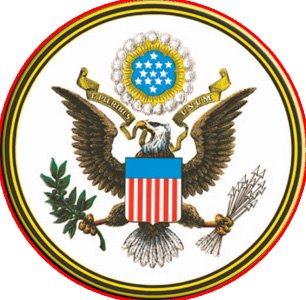
The Great American Seal

The Great American Seal hexagramThe following paragraph is from Dr. Asher Eder’s book The Star of David, which was published in 1987 in English in Jerusalem by Rubin Mass Ltd. The publication here is courtesy of Oren Mass
In the culture of India, where it must have been known since ancient times, the six-pointed star still plays a role. It is found there in Hindu temples and shrines, and also on the flag of Indian ships, while in Nepal it is embroidered on the front of the king's headgear.
There, it is considered a symbol of harmony between spirit and matter. In Yoga schools, this idea is well expressed by graphic representations of the human chakras7 with the star marking the heart chakra as the central and connecting link between the three lower "carnal" chakras and the three upper "spiritual" chakras. While the lower and upper chakras are all represented by Sanskrit letters, it is noteworthy that only the heart chakra is depicted by an abstract sign, the six-pointed star.
In the tantric teaching, the star serves as a symbol for relationship between man and wife.
Some Indian tribes of North America have used it "since ancient times as a symbol expressing the wisdom of 'as it is above, so it is below', as well as the union of spirit and matter, heaven and earth."8
While each state of the United States of America is represented by a pentagram in their "Stars-and-Stripes" flag, their Great Seal incorporates a six-pointed star; or, to be more precise, a hexagram-like arrangement of the thirteen pentagrams which represent the 13 founding states of the USA.