Wednesday, October 25, 2006
Tuesday, October 24, 2006
Orvietto Cathedral
In the middle of this splendid column there's a raw of interlaced hexagrams.It is standing in Orvietto Cathedral, an ancient town in Umbria, Italy.
Infobitch commented under this photo in Flickr in Hebrew that he wants such a column in his guest room. Photo is courtesy of "hassi" from Flickr.
Valencia Cathedral Facade
I already published this magnificent hexagram as it is seen from the church outwards. I thought it's a good idea to show it also from the facade, which is not less magnificent...The following paragraph is from Dr. Asher Eder’s book The Star of David, which was published in 1987 in English in Jerusalem by Rubin Mass Ltd. The publication here is courtesy of Oren MassIn Christian culture, evidence of the Star of David can be found in some Byzantine churches as carvings and as wooden seals.1 It was also used as a design element in mosaic floors such as that found in a chapel excavated near Mishor Adumim in the Judean desert; or as that in Kafr Makr (Western Galilee); or as carvings; now on display at the Israel Museum:
Byzantine churches in other countries showed it, too (one in Paphos, Cyprus, embeds two hexagrams among other designs on its mosaic floor).
In Europe many medieval cathedrals and churches display the star: notably those in Burgos and Valencia Spain; Florence Anagni Aquileia and Orvieto Italy; and Brandenburg Stendal and Hannover Germany.
There is also the famous Perpignon Bible of 1249 which is decorated with a beautiful hexagram.
In the secular world the kings of Navarra used the star on their seals in the 10th and 11th centuries as did other officials and notaries.
Ironically modern Portuguese policemen wear it on their headgear, several centuries after the Jews of that country were branded by it.
An Italian newspaper of 1622 A Coranto had a hexagram as its imprint.
However in the course of time Christians came to prefer the five-pointed star (see Chapter 27)acknowledging the six-pointed version as a Jewish symbol.
Click to see more:
Christian,
Doctor Asher Eder,
Hexagram
Valencia Cathedral

A marvelous black hexagram on a stained glass window.
Picture is courtesy of "Molas" who published it on Flickr
Monday, October 23, 2006
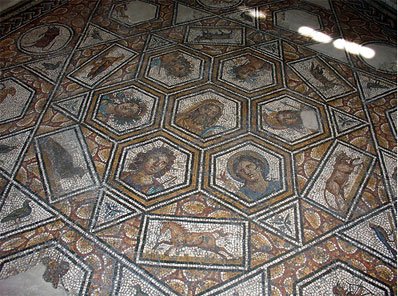
Zodiac in a Hexagram

It is hard to see the hexagram that frames this zodiac floor, because the camera is too close to the mosaics, but you can see it better here.
In the middle of the picture there are seven Roman emperors who represent the seven days of the week or the Sun, Moon, Mercury, Venus, Mars, Jupiter, and Saturn. Around them the animals sacred to them: wolf, eagle, dove, horse, bull and goat. Around them the signs of the Zodiac.
This well preserved zodiac floor from the third century C.E.is now in the Bardo Museum in Tunis, but it was discovered in Bir-Chana near Zaghouan ,in central Tunisia.
Picture is courtesy of "bibbijian" who published it on Flickr.
Burgos Cathedral
Six pointed star in a rose window in the Gothic-style cathedral in Burgos, Spain. The cathedral was built in the 13th century but the main façade was reformed in the 18th century.Picture is courtesy of "Sandra Mora" from Flickr
Subscribe to:
Posts (Atom)