Sunday, January 16, 2011

Paolo Da Visso 1450

Painter Paolo Da Visso painted the Madona and on her robe printed in gold a few stars of David
Exhibited at Avignon, Musée du Petit Palais

Six pointed stars on a Byzantine Coin

Anastasius I, 491 - 518 C.E.
Bronze follis (coin) minted in Constantinople, 512  C.E. The M marks 40 nummi
Along with a cross above the M

The Fleur de Lys symbol in England

From: The Handbook to English Heraldry by Charles Boutell, 1914, 

The fleur de lys entered France by LOUIS VII. (A.D. 1137-1180) as his royal emblem …his lily shapes were scattered and his emblem is named as “France Ancient”: 

France Ancient


About A.D. 1365, CHARLES V. of France changed the number of the lily shapes  to three; and this emblem is named as “France Modern”: 
                   
France Modern

Angel of France Modern
CC picture by Lawrence OP/Flickr


In 1299 EDWARD I married Margaret of France, and she introduced the Fleur to two of her seals  

 Margaret, Queen of Edward I 


Margaret, Queen of Edward I -  Royal Tudor arms
Cambridge Chapel, England
CC picture by Lawrence OP/Flickr

             Margaret, Queen of Edward I


In 1340, EDWARD III. claimed the crown of france, and added the France Ancient to his lions of england.

Perhaps in 1405, HENRY IV added the France Modern to his shield.


The position of the three fleurs de lys was more than once changed in the Royal Shield of England, and they were finally removed in 1801 because after the French Revolution, the Kingdom of France had ceased to exist.

More about the Fleur de Lys and its connection to the Star of David on

Saturday, January 15, 2011

Polarities


Picture is copied from Wikipedia and it shows a hexagram from 15th Century, gouache on cloth from 'Jain Cosmology', Ravi Kumar, 2005, ISBN 8187330082

The following paragraph is from Dr. Asher Eder’s book The Star of David, which was published in 1987 in English in Jerusalem by Rubin Mass Ltd. The publication here is courtesy of Oren Mass
One of the most conspicuous characteristics of the created world is its multiple polarities. Following the original polarity of Creator-Creation, there are polarities in every dimension of Creation, such as spirit and matter, North and South pole, male and female, positive and negative in electricity, and so forth. The Chinese principle of yin-yang also expresses aspects of polarity.
A striking example of two opposing forces forming in their balance a very beneficial energy field are the centrifugal energies of the planets held in their positions by the gravitational pull exerted by the sun. Without the latter, the planets including our earth would spin somewhere in the void of the space; and without the former, they would plunge into the sun and melt in its atomic furnace.
When looking closely at any of these examples, we notice that some of them consist of two related power fields, such as male-female, while others are two sides of the same force, as in the case of electricity. Without flow, the latter would exist only as potential. In fact, physics gives each case its specific properties, but for our purposes, we shall group all of them as polarities, and concentrate on the relating force between their respective "poles".
No pole could exist without its counterpart, nor could there be poles without this relating force. For instance, an atom would not be an atom without the force between its positive and negative particles, nor could the species continue to exist without the force between its male and female partners.
On the other hand, we will not find any polarizing force between statues of a male and female, or between a male fish and a female bird. Properly understood, all polarities, including that of spirit and matter, are categories of relationships, and not contrasts. Thus, poles are not antagonistic sites; they are opposite yet related points in a field of energy. The bar magnet with its field of force made visible by iron filings demonstrates this clearly.
Interestingly enough, the very first statement in Holy Scripture indicates polarity: "In the beginning God created Heavens and Earth." Here, the word heavens (שמים , shamayim) denotes both the sky (רקיע , raqi'a) which at a later stage is also called heavens, שמים (vs.8); and a spiritual entity, often referred to as "The Kingdom of Heavens." This Kingdom of Heavens exists on Earth - its material pole. Obviously, all of us are exposed to, and permeated by, this polarity, whether we recognize it or not.
An interesting question was raised already in ancient times: "Where do the heavens begin? Beyond the clouds? Beyond the atmosphere? Beyond the moon?" The answer was: "Approximately a yard above the ground" - that means to say in the area of the diaphragm of an adult, whether he lives high up in the Himalayas, or whether he works as a miner hundreds of feet below the surface of the earth. All the organs below the diaphragm are carnal while those above it can, and should, express also spiritual or Divine qualities (as e.g. voice; intellect; self reflection; mercy; forgiveness). The "lower" are to be guided and treated by the "upper" organs and the qualities they carry. The heart with its double nature , symbolically located just above the diaphragm, plays the role of the connecting "chakra", as mentioned in Chapter 2 - THE SIX-POINTED STAR IN OTHER CULTURES and in Chapter 7 - THE KABBALISTIC TREE OF LIFE.

Dr. Asher Eder's notes to this chapter:

1) In the state before Creation - ein soph - no polarity exists.
2) Cf. Rashi Gen.2:7. Heavens, as distinct from firmament (רקיע , raqia), and sky (,שחקים
shehaqim). However, from Gen.1:8 on, the firmament is also called heavens.
3) The word שמים , shamayim, can be derived from the word שם , shem, name, referring to the Name of the Lord. The dual form שמים, would then refer to both the Lord's Name and to the priestly tribe of Shem, which bears the Divine Name on Earth (Hirsch, Genesis; also Num.6:22-27, note 15 of chapter 8, note 3 of chapter 12). However, שמים can also be derived from the word מים, mayim, water, and would then mean "that which is water". Allegorically, water can stand for truth (cf. Baba Kama, 17, p.I), and for nations (cf. Ps. 124:2-4; Is.17:12). Even in this case, the waters below the firmament would, naturally, "be gathered together into one place", but might finally rejoin the "upper waters" in the Name of Names, i.e. in the "Kingdom of Heavens". - In Kabbalistic thought, the word שמיםis a combination of the signs, standing for ,אש esh, fire; and מ, mem, water.
Some scholars see the word שמים as deriving from שם, sham, there (i.e. that which is beyond or far from the earth), but this would not explain the dual form of שמים , shamayim. It would also contradict the prophetic teaching about the Kingdom of Heaven, which is to be established on the Earth, and not somewhere outside. However, see also note 13 of chapter 20.
4) The Hebrew language knows two words for heart: לב, lev; and לבב, levav. In the latter, the doubling of ב may indicate this double nature. We should love the Lord our God with all our (double natured) heart (לבב - Deuter. 6:5; 1.Kings 8:61) so that we will serve him willingly “with a perfect heart” (לב , 1.Chron. 29:9)

Friday, January 14, 2011

Six pointed star in Rangoli- Video Clip

The traditional decorative folk art of India 
Rangoli, Jayanagar , Mysore, India

Wednesday, January 12, 2011

Star of David in Jewish Printed Amulets

Deluga, Waldemar, and Iwona Zych in their article titled  “Jewish Printed Amulets.” |(Print Quarterly 20, no. 4 (2003): 369-373.) claim that the Star of David appears on many Printed Amulets that once hung above a newborn’s bed. It appears under the opening text which is always from Psalm 20."The oldest known amulet was made as a single-leaf print in Prague in the 17th century. The woodcut illustrations have clearly been reused in this amulet; the original woodcuts were probably quite worn. Elements of the typographic decoration resemble those in Czech prints. It seems that the blocks used in some Jewish prints in Prague were exported to other European locales”.

CC picture from Jewish Encyclopedia

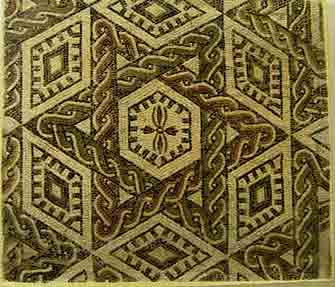
Roman Hexagram, Guilloche Style

Guilloche is a decorative border made of interlaced bands Guilloche
Compare:
Picture was taken at El Jem museum, Tunisia. Courtesy of ajhammu0 / Andy from Flickr.
Beginning of third century. At the centre an hexagon, in the middle of which a cruciform flower which indicates that it belongs to christians.