Saturday, December 16, 2006

Magen Dawid

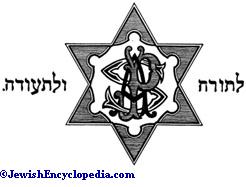
Picture is copied fron the Jewish Encyclopedia and it shows the logo of the first Jewish organisation who adopted the Star of David as its logo in 1873.
I tried to find out what the Jewish Encyclopedia (1901-1906) has to say about the Star of David but searching for these words or for Magen David yielded nothing, because the article was under the title MAGEN DAWID. Later I found out that I could have found the article by searching for Shield of David.
Anyhow, the article was written by Joseph Jacobs and Ludwig Blau long before the Star of David found its central place in the Israeli flag. It was fascinating to reveal how fresh and informative is the article even today.

It starts by describing the form of the emblem:
The hexagram formed by the combination of two equilateral triangles;
Then goes on to describe its usages:
used as the symbol of Judaism. It is placed upon synagogues, sacred vessels, and the like… In the synagogues, perhaps, it took the place of the mezuzah
Close to the end of the article it refers to the source of the name:
and the name "shield of David" may have been given it in virtue of its protective powers.
It refers to the adoption of the shield of David as a Jewish national emblem:
1. Adopted as a device by the American Jewish Publication Society in 1873
2. the Zionist Congress of Basel
3. "Die Welt" (Vienna), the official organ of Zionism.
4. By other bodies.
5. The Chebra Kaddisha of the Jewish community of Johannesburg, South Africa, calls itself "Cebra Kaddisha zum Rothen Magen David," following the designation of the "red cross" societies.

The main part of the article is dedicated to the history of the Magen Dawid:
1. Introduction
2. Archeological artifact 
3. Literary sources
4. Cabala
5. Charles IV.
6. Usage by other cultures:
a. Hindus
b. Christians
7. The hexagram’s relation to the pentagram
8. Bibliography

Enigmatic sign in India

Picture is courtesy of Shira Golding who published it on Flickr under the title "Magen David available here".

The Dimensions

The following paragraph is from a new chapter, The Time Space Correlation, which doesn’t appear on Dr. Asher Eder’s book The Star of David, which was published in 1987 in English in Jerusalem by Rubin Mass Ltd.
In daily life we see space as composed of the three dimensions length, width, and height. If we wish to see time as the fourth dimension as customary in modern science, the relation between time and movement would become the fifth dimension (depicted by line b-c of the figure), and movement itself the sixth dimension (line a-b). However, it would then be more appropriate to speak of movement as the first dimension, time the second, and the relation between them as the third dimension, while length, width, and height would be the fourth, fifth, and sixth dimension respectively.

35-10. 9- Change or halt of movement.
In case the forces underlying the movements should change in their magnitude or in their relations to each other, time would change accordingly (e.g. the days and/or the years would become longer or shorter). Consequently, also life would be different, provided the changes would not be too drastic, as mentioned already in par. 4.
In case all movement in the universe would come to a halt, the dimensions of space (length, width, height), and along with them time, would collapse, for the existence of these depends on the movements and their underlying forces. This would be paramount to absolute death. It is for this reason that sphere shaped clusters of stars (which do not spiral like galaxies) are considered by science as lifeless.
All this shows that time and space are two different, yet related functions of the movements and their underlying forces which keep up the universe, and give it life.

35-1. 11- Our world
The world we live in, or, to be more correct, what our senses perceive as world, is depicted by the hexagon g-h-i-k-l-m, i.e. the middle field with its six edges (1+6). This world is indeed characterized by the number 7 -- as e.g. the 7 colors, 7 notes in music, 7 days, 7 chaqras, and in accordance therewith the seven- branched Menorah as a symbol of harmony and peace for man on earth. Within this frame, the Holy Scriptures do not teach history as linear sequence of events; they rather show us man's story - "his story" in light of the Divine.
The small triangles 1-6 around the middle field could depict the beyond, while the sign "oo" may indicate infinity, eternity.
The small triangle a-k-i could depict the first moments after the supposed "Big Bang". Probably it will forever remain beyond our capacity of research and comprehension. Before creation, or the "Big Bang" in modern terminology, there was anyway no time, nor were there movements or physical laws of the sort we know.
35-12. The curved lines.
We are accustomed to see the lines g-h, k-l, etc, as straight lines while in fact they are bent like their corresponding lines g'-h', k'-l', etc. In case we prolong the line: endlessly, it would go around the globe and return to its starting point, i.e. it is in fact a bow as part of a huge circle, the degree of its bend being equal to that of our globe.
In case we would allow the line to leave the globe and go on endlessly in the universe, i.e. if it would travel uninterruptedly through the space bent in itself, it would likewise return to its starting point. (There are indeed astronomers who are of the opinion that the farthest galaxies we see through our telescopes might be our own one and those nearest to ours - as if we would so-to-speak look into our back).
35-13. 12- The center
In the hexagram, the centers of the two equilateral triangles merge, and their harmonious joining forms the hexagon, the symmetric middle field. In our figure its center is marked by the number 7.We may see it as the hub, and resting place, in time and space, these being depicted by the lines a-b and a-c, while our "world view" of them may be represented by the line b-c.
This mathematical resting place, the center of the hexagram, and the center of our innermost being are essentially congruent and one. The more we bring the rest of our being closer to this center, the more we will be in harmony and peace with ourselves and with our surrounding, and the less we will feel a self-imposed time pressure.
Observing Shabbat every seventh day is in fact a sanctification of a certain time unit (equal approximately to one revolution of the globe) during which we abstain from the labor of the six days of the week - i.e we cease to operate forces of labor - and enter for a full day into the calm, or rest, enhanced by prayer and the like (the Hebrew word for prayer, תפילה, tefilah, could well be rendered as tuning into the Divine). Indeed, our sages summarized the essential difference between a slave and a free person in one word: time. A slave's time is not his own. True, a spiritually strong person may feel free in his thoughts even if he is enslaved by a Pharaoh, or be imprisoned by (former) Gestapo or KGB, but he is not free in time and movement. He cannot use his energies freely.
In our graph, we may freedom see symbolized by the number 7 (the hub of the wheel, so-to-speak. See also fig. 52). Geographically, this place of "Divine rest" is located in the "Even Shetiah", the center of Mount Moriah, or Temple Mount. As time and space are linked, so should Shabbath and the Sanctuary be linked. If separated, both of them suffer - a picture of our present world.

35-14. C. Shortcomings of the design
1.) Since the hexagram is merely a geometrical figure, it cannot fully depict the universe which is a multi-dimensional entity.
2.) The universe seems to expand (and perhaps may eventually contract). A geometric figure cannot depict such movements. It cannot show the actions and interactions of the different forces either. Besides, we should well keep in mind that there might be forces operating in the universe which are not yet known to us; nor do we fully know those which we think we know as e.g. electricity, gravity on the so-called material level; and love, hatred, will power etc on the so-called spiritual level. I use the word so-called because there is no clear-cut separating line between these two levels.
3.) The figure does not show the deflection of light rays in the universe caused by other heavenly bodies, and what that means for calculating the distances between them.
4.) Dot "a" of the figure depicts the creative force although the latter cannot be limited or described by a point. It could better be described as the primary starting point. Due to the hexagram's symmetry, it could be marked at anyone of its six points. In turn, this gives us a hint that actually we cannot "fix" the Creator and the beginning of Creation to a point of our choice.
5.) The "age of the universe" (as mentioned above in par. B,3) is calculated on the base of measurements taken from the situation our globe is in at present: a second is the 86400th part of a day, i.e. of the period needed by the globe for one revolution; and a kilometer is the 40000th part of the length of the equator. The speed of light is given by approximately 300000 km/sec (i.e. a flash of light would go seven and a half times around our globe within one second). Does our globe, and consequently also its equator, expand in the same rate as the universe? If so, would that change also "c", the constancy of the speed of light, and consequently also the "measure" of the distances in the universe? The hexagram cannot say anything about these questions. It pertains to the situation on our globe.
6) All this shows us that the hexagram is foremost a symbol for our situation on earth.

Friday, December 15, 2006

Happy Hanukkah to all my Readers

Star of David on a Hanukkah Menorah reminds me of the beginning of this blog. One of my main objectives was, and still is, to circulate Uri Ofir's research, which claims that the origin of the Jewish Star of David is from the Tabernacle Menorah which was made by God right after the Exodus.
Picture is courtesy of brixton who published it on Flickr.

Coexist

Picture is courtesy of "marcusg" who published it on Flickr with the collowing caption:

[U2 lead singer] Bono said this was grafitti he saw... calls to peace between the religions, Islam is represented by the cresent moon, star of david for the Jews and Christian cross.
To me it looks like a modern version of the three rhombs idea that is discussed at length in Asher Eder's book THE STAR OF DAVID. 

Bono referred to this symbol as he sang, “Jesus, Jew, Muhammad, it’s true…All sons of Abraham. Father Abraham, speak to your sons. Tell them, No more!”
Bono first saw the “Coexist” symbol painted as grafitti on a wall in Chicago.

Coexist is actually the work of Piotr Mlodozeniec, a Polish graphic designer living in Warsaw. He created the CoeXisT image in 2001 for a contest hosted by The Museum on the Seam for Dialogue, Understanding and Coexistence in Jerusalem. 

Perspective of Time


The following paragraph is from a new chapter, The Time Space Correlation, which doesn’t appear on Dr. Asher Eder’s book The Star of David, which was published in 1987 in English in Jerusalem by Rubin Mass Ltd.
We got accustomed to see time as a continuous flow from its beginning through the present into some future. In western culture, history is conceived as a chain of events to be taught in their chronological order. In that concept, an event can happen only once.
The term linear time gives expression to this concept. In that current of linear time we seem to ride on one of its waves downstream.
Yet, nearly every language knows also terms beyond this concept. For instance, we can use the word "once" both for events of the past and of the future: "Once there was...", "once there will be...". Another term going beyond the above concept is "ocean of time". An ocean may have different currents, but we, somewhere in the ocean, are surrounded by it. We may feel directions towards the left or towards the right; or north-south; etc.
In the Hebrew language, this notion found its expression in the words ים, yam, ocean; and יום, yom, day. The latter, by inserting the sign ו, wav, designates a position in the ocean. The plural form of both these words is ימים, yamim, which can be read days, or oceans. בלב הימים, in the middle (liter. heart) of the days, we are also in the middle (liter. heart) of the oceans, engulfed by them. The above linearity of time dissolves in the presence. We may see this awareness as the first requirement for prophecy, as well as for forgiveness. In pursuing the latter, we can retrieve past events, go through them again, but now with a different and more elevated attitude which enables us to loosen their impacts.
Our graph depicts all this impressively. Any confinement to the concept of linear time is expressed by the line b-c. There, we observe the movements, or events, in their chronological sequence, and order them accordingly in that kind of world view. But once we move toward the center, marked by the number 7 in our graph, we are not only like in the middle of the ocean of events and times, rather more portent we are in, or at least near, the center of our true innermost being, so-to-speak beyond and above the events of past and presence (these are marked by the lines a-b, and a-c). We have reached a stage of a broader and more comprehensive understanding.

Wednesday, December 13, 2006

Four Different Times

The following paragraph is from a new chapter, The Time Space Correlation, which doesn’t appear on Dr. Asher Eder’s book The Star of David, which was published in 1987 in English in Jerusalem by RubinMass Ltd.

Theological terms like אחרית הימים (aherit ha'yamim, latter days), or קץ הימים (qez ha'yamim, end of time) are to be understood on their level, i.e. subjectively: they mean to say that we human beings, individuals and eventually mankind as a whole, can raise to a spiritual level where time and infinity merge.
“To every thing there is a season, and a time to every purpose under the heavens”, is a well known saying (Eccles. 3:1). That is, the “circumstances” – namely the relevant forces – have to be ripe for the event in view. On the people’s complaint that “the time is not come”, the Prophet answered “The time is yours” (Hag. 1:2,4); that is, make yourselves ready, put yourselves together. We may also note the term “under the heavens”. It tells us that time concepts and feelings belong to the realm of our concepts and feelings; but above the heavens, “beyond”, there is Omnipresence.
In this context we should look briefly at the terms eternity and infinity. The former means endlessness of duration beyond or outside of time (time has by definition a beginning and an end!); while the term infinity relates to quantity, and thus it is used to describe endlessness of space. Yet these two concepts merge; for, logically speaking, there cannot be an infinity besides an eternity: Infinity of space and eternity of time are One.
This concept of oneness finds its verification also in the Hebrew language: There, one of the epithets of God is המקום (ha’maqom), literally the place, or the space. The gamatria of מקום (maqom) is 40+100+6+40=186; and that of the Four-Letter-Name (י+ה+ו+ה) is 10+5+6+5=26. When we square each of these components, we get:
102 + 52 + 62 + 52 = 100+25+36+25=186, which equals exactly the gamatrical value of מקום, maqom. We may conclude that creation of space (quantity) is but an amplification of the Lord’s potency, with time as one of its innate components. While we may draw conclusions from our observations of the created world about its Creator, He reveals Himself to us in the time aspect: Through Moses He made His Name known as “אהיה אשר אהיה (=I shall be that I shall be; not: I am that I am, as often rendered incorrectly); and the two signs of the Covenant with Israel have time components as essential ingredients: the circumcision at the eighth day; and the keeping of Shabbat every seventh day. Then, there are the Feasts (מועדים, “fixed dates”) of Pessah, Shavuoth (50 days after Pessah). and Succoth (Feast of Tabernacles); also Rosh haShannah, the Jewish New Year with the Day of Atonement 10 days thereafter.
Other basic commandments, too, as e.g. the respecting of the women’s periods, relate to times; and so do even those which involve places. Most noteworthy in this respect is the Temple Mount: Notwithstanding the fact that all creation is the Creator’s PLACE – His Omnipresence - (מקום, maqom), He has ordained a special place (maqom) as the place of worship for all nations (Deuter. 12:5 et al; Is. 56:7 et al): Mount Zion, the Jerusalem’s Temple Mount.
Although there can, logically speaking, be only one eternity, we use yet terms like in all eternities; from eternity to eternity; eternity and beyond. They are mathematically and logically incorrect and should be understood as an attempt to convey the idea of immense time spans we cannot comprehend anyway.
Very revealing is in this context the Hebrew term for eternity, נצח (nezah): it means also victory. Endless duration of the (Divine) prevailing force and victory are seen as identical.
Summing up we can say that there are four different times:
a) the universal time about which we know hardly anything notwithstanding different theories about a "Big Bang" and the supposed time which passed since then. More relevant to us are the astrological times of the zodiac.
b) The time governing our globe due to the constellations and movements of sun, moon, and earth. With regard to the age of the latter, we would first have to decide from which stage of its development we can speak of it as a planet, or globe.
c) Religious times as e.g. Yom haKippurim (Day of Atonement); Shmittah; Yovel; or Advent in Christianity and Ramadan in Islam; etc. In fact each religion/culture knows specific time circles within bigger time circles, apparently in an attempt to raise man's consciousness above the limitations of the physical world.
d) Each one's personal time ("60 years old" counted from the date and hour of birth), given to us to grow therein physically, mentally, and spiritually. Our so-called biological clock is part of this personal time of ours.
In this context, we should take a brief look at a term which became very fashionable in recent years: going backwards in time. Based upon sub-atomic experiments in which particles appeared to move backwards in time, unrestraint fiction stories on the subject were sold widely for good money. There is no going backwards in time although from an abstract mathematical calculation it may sometimes appear to be so. We may compare this to a common experience. When traveling from west to east or from east to west we have to adjust our clocks, and when crossing the dateline, we even may have to deduct the date of a day, or add the date of a day. This does not make us one day or one minute younger, or older, although from a certain point of observation it may appear so. This would be true even in case we would travel in an airplane with a speed surpassing the rotation of the globe. The same holds in principle true also in view of the above mentioned sub-atomic experiments.
In view of the macrocosm, scientists have raised the question whether the universe which is at present conceived as expanding, would contract after reaching its culmination, and whether such a contraction would entail a reversal, or winding back, of time and of the processes which occurred during the time of expansion. It would not, of course. Reversal of a process (movement) may undo the effect of the preceding process but it cannot undo the process itself. Rather, the time (duration) needed for the reversal will have to be added to the time (duration) of the preceding process, notwithstanding the possibility that the times sensed during a process of contraction of the universe could be different from our present one.
The Zen saying quoted above: "What did your face look like before your father and mother were born?" does actually not relate to time. It is rather a question appertaining to quality, and could be answered by a kabbalistic term; "It was the face of Adam Kadmon" (the archetypal man, Gen. 1:26,27).