 Magen David appears in the stained-glass windows of the former synagogue of Deventer, Overijsse, Nederland. It was sold to a protestant congregation...
Picture is courtesy of "rogiro" who published it on Flickr.
Magen David appears in the stained-glass windows of the former synagogue of Deventer, Overijsse, Nederland. It was sold to a protestant congregation... This is a Pomegranate-Flower photo I took from my friend Mike's unique orchard. To me it looks like a Magen David.
How could Moses, our teacher, give expression to the above ideas of leaving Egypt not merely geographically, without denying altogether the nature forces it represents, but rather utilizing them in the future build up of the Land of Promise under the guidance of the Lord and his Torah? Was there a simple, yet instructive symbol which would show this aspiration? If there was one, how could it be applied without deceiving the people to deify and worship it?
For many years I wondered about the reason for the commandment to fix “pomegranates and shells at the priest's hem". (Gen. 34:28
The pomegranate is known as one of the seven minim, the so-called holy fruits of the country enumerated in Deut. 8:8. It is the only fruit whose image was a permanent constituent in the Temple service. Images thereof were added on the High Priest`s robe on the command of Moses:
"And they made upon the hem of the robe pomegranates of blue, and purple, and scarlet, twined; and they made bells of pure gold, and put the bells between the pomegranates...a bell and a pomegranate, a bell and a pomegranate round about the hem of the robe to minister in; as the Lord commanded Moses" (Exod. 39:24-26).
While many ears could hear the tinkling of the bells, few eyes could see the colorful little pomegranates. Maybe it was for this reason that pomegranates were also put on the chapiters of the pillars named Boaz and Yakhin in Solomon's Temple, and were thus made visible to all: "And four hundred pomegranates for the two networks... to cover the bowls of the chapiters of the pillars" (2.Kings 7:42).
Folklore links the pomegranate to wisdom and plenty ("may your wisdom, or your good deeds, be as plenty as its kernels"); but only the fruit's round shape and its calyx were visible.
It was probably the calyx which made the pomegranate eligible for a permanent Temple utensil that could serve as such a symbol as mentioned above.
We may deduce this from the ivory pomegranate of the 8th Century B.C.E. now at display in the Israel Museum, Jerusalem. This artifact has an impressively oversized calyx with six sepals (four still existing, two broken but well discernable). While its inscription which reads in English "Holy (to the) priests of the House of the Lord", has been exposed as recent forgery, the message of that artifact seems to remain undisputed.
The artist who designed this ivory pomegranate, was most likely inspired by the shape of the young fruit when it begins to develop right after the flower:
It is remarkable that he chose this design, and that in addition he emphasized the calyx even more. That may also be the reason for accepting it originally as authentic.
What is more, this ivory pomegranate with its six-pointed calyx is quite different from similar artifacts of that period (from the l2th to the 6th Century B.C.E.) also on display in the Museum. Canaanite ones have five- or seven-pointed calyxes and are normal-sized, while Edomite ones from Qidmit in the Northern Negev, also of the 7th - 6th Century B.C.E., hanging on an incense burner, have four sepals, and are normal sized, too.
We may conclude that it was probably the calyx which made the pomegranate eligible for a permanent place in the Sanctuary, upon the priest’s hem.
All these numbers are in accordance with nature; for indeed the number of the sepals which form the pomegranate`s flower cup can range from four to nine. Most common, however, are those with five, six, or seven sepals. Consequently, the calyx of the fruit can be also five-, six-, or seven-pointed. The fact that the calyxes of the Canaanite images have five or seven points, and the Edomite ones have four (so-far, none is known with six points), while the one in discussion, probably a Hebrew one, has six, seems rather significant. The numbers five and seven may relate to phenomena in nature, e.g. five fingers, five senses, the Druidical and the Babylonian pentagrams and what they symbolize; or the seven colors; seven tones in music; etc. The number four may just be symmetric, or simply ornamental, or may relate to the four directions of the rose.
The six-pointed calyx, however, can easily be seen as forming a symmetric hexagram, a geometric design which we know as Magen David, the Shield of David, or Star of David.
As we saw in the main chapters of the book, the hexagram is composed of two interwoven equilateral triangles which may symbolize Creation's polarities in their interaction and balance (e.g. Creator and creation; male and female; spirit and matter; heaven and earth).
So far, no remains from the First Temple were discovered. Yet, would it seem too far fetched to conclude from the above mentioned artifact of the First Temple period that there existed an affinity of the Hebrews to the six-pedaled pomegranate? An affinity which in turn may have led them to fix pomegranates of that design on the chapiters of the columns Yachin and Boaz visible to those who enteed the Temple; and then on the hem of the High Priest’s who served in the Sanctuary?
If so, the pomegranate as one of the seven minim with its six-pointed calyx could remind the people of these polarities, and draw their attention beyond the physical cosmos betokened by the pyramid and the cosmic numbers it represents.
Being a permanent Temple constituent, it could help bring the worshipper constantly to the awareness that man is the only being in which both aspects, spirit and matter, can be found from the very day the Lord breathed the neshamah, the Divine soul, into him.
Contemplating on the pomegranate with its oversized six symmetric pedals could induce the worshipper to reflect on all the polarities in and around him, and on the Lord God, the Creator of all whom he confesses in his worship, as One.
I heard today from Rabbi Moshe Rabovitz of Shaarei Hesed, Jerusalem, that Kosher Butchers in Europe for the last few hundred years always used the Magen David sign outside their establishments to announce that triangular (kosher) meat was inside.
He believes the reason is to be found in the Talmud Baitsa 28:a where it says that it was the practice for Kosher butchers to cut Kosher meat into triangular form so that it could be distinguishable if non-Kosher meat accidentally got mixed up with it.
The Magen David sign is simply two triangles superimposed on each other
 Picture is courtesy of artist EricGjerde from Flickr who made this amazingly complicated Star of David origami
 The following paragraph is from Dr. Asher Eder’s book The Star of David, which was published in 1987 in English in Jerusalem by Rubin Mass Ltd. The publication here is courtesy of Oren Mass.
In the attempt to trace the history of our symbol, we discovered that it was known to diverse people from ancient times. We followed its history through the Middle Ages to its adoption in modern times as a specific Jewish symbol and the flag symbol of the State of Israel.
Yet, its symbolic meaning remains universal. Such polarization is fascinating wherever it occurs in nature, but above all illustrates many features characteristic of human life.
Looking at it from this angle, the symbol might have been known to Adam, the first man. As soon as he heard the Divine voice permitting him to eat from all the trees of the garden except from the Tree of Knowledge of Good and Evil [Gen.2:16,17] ,and then heard the reproach: "Where are you?", he must have become aware of the existence of a spiritual world beyond the physical one in which he found himself, and realized that these worlds penetrate each other. In his long life, in which he would observe the heavenly bodies and see their impact on earthly life, he could well have developed the basics of statistics, mathematics, geometry, and astronomy, including the triangles.
In other words, our symbol may well have been a universal sign from the beginning; it need not be confined to the Jewish people and its state. The Israelites are but Mankind's priests, pointing out the road which will take Humanity to the Kingdom of Divine Grace and Justice on Earth, as proclaimed 3,000 years ago by King David, after whom our symbol is named.
Our six-pointed star may well turn out to be the emblem for all Humankind. It can again become the Sign of Man.
 Picture is courtesy of "Mélisande" who published it on Flickr.
 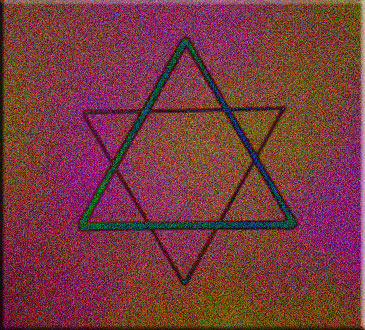 The following paragraph is from Dr. Asher Eder’s book The Star of David, which was published in 1987 in English in Jerusalem by Rubin Mass Ltd. The publication here is courtesy of Oren Mass.
The joining of the two triangles, whether they represent the relationship between God and Man, male and female, Israel and the nations, or religion and science, has to be harmonious - a symmetrical star.
If one of the two entities represented by a triangle insists on having only his own concept prevail and his own position acknowledged, we would have, not a star, but a single triangle resting on its base, similar to a pyramid. Such an individual's upward aspiration for a "better world" would in practice become more constricted, until the sides of the triangle intersect. As a point cannot be defined either mathematically or otherwise, likewise this point of intersection cannot be defined, but it could easily turn out to be the point of isolated fanaticism, or obsession, where misplaced enthusiasm or sheer despotism replaces insight.
The fate of such a "single-triangle" individual can be compared to that of the builders of the Tower of Babel, with its broad base yet narrow top intended to reach heaven and serve as a rallying point. Both sides of that triangle act as a shelter to screen off any influence from above. However, although this influence is not acknowledged by the adherents to this kind of thinking, it is still there, and causes the "Babylonian confusion".
If such an attitude prevails, and one could manage to impose it on others, the triangles of the hexagram would not be interwoven; instead, one triangle would impose itself on the other, repressing it and pushing it into the background.
The result would be that the individual who holds such a view, and any individuals who have been persuaded to believe it possible to abandon their own in its favor, would find themselves, first, in opposition to the Divine, and ultimately, at odds with each other - for every individual's proper place in the scheme of things is as unique and as unalterable as his fingerprints. Thus, as the "tower" rises and narrows, the individual's uniqueness would find itself increasingly constricted; tensions would arise and eventually erupt. As each person's individuality finally asserts itself, it would become clear that, all declarations of "loyalty to the cause" notwithstanding, each participant had been laboring towards his own goal... a goal different from that of any other participant. Confusion and chaos would inevitably ensue
This sign does not show harmony and peace but rather tension and imposition, which trigger revolt. Human history so far has indeed been the "history of the revolts of the oppressed against the oppressors."
Imposition and oppression are, of course, not the purpose of history, regardless of whether such oppressions emanate from political, clerical, feudal, industrial or other causes. As the Lord God does not impose upon Man, likewise Man is not meant to impose upon, or oppress, his fellows.
In view of our present subject (religion and science), this means that both sides should see themselves as servants of God and Man, of the Creator and all His Creation, with each one contributing and receiving his due, and accepting the other's role in complementary cooperation, as symbolized by the six-pointed star:
In our symmetric six-pointed star the joining of its two triangles symbolizes, and even teaches us well the Divine Principle of harmonious mutuality and complementation of the related energy fields.
True peace, whether on the personal, cultural, social or political level, will be achieved only to the degree that we can raise our awareness from the selfish to the holistic level, in which everyone plays his part in completing the whole.
Indeed, the word Shalom, peace, means completion, literally and figuratively. It derives from the root word, shalem, complete, whole. As a verb, shalem means to recompense, to pay a debt, to make whole. Thus the word conveys a universal truth: we will have peace only inasmuch as we pay what we owe to one another as well as to the Creator and the rest of His Creation.
As C.G. Jung says: "The right way, like the wrong way, must be paid for." The difference is that for the right way we pay in advance, following our insight, while for the wrong way we pay afterwards - a much higher and more painful price.
But what about the pentagram which symbolizes the sciences? Science, according to its own definition, deals with the counting, weighing and measuring of the phenomena of the created world, and with the condensing of the findings into law. Thus, we could put the pentagram into the middle field of the hexagram:
However, this would not contribute anything, as both the pentagram and the middle field of the hexagram, which expresses by its two triangles the harmonious balance of both the material and spiritual aspects of the universe, does not need any supplement; it is complete in itself.
In recent years, it became fashionable to depict the hexagram in different shapes -- triangles with unequal sides; prolonged triangles; one of the two triangles replaced by a dove resembling a triangle; giving one or two sides of a triangle the shape of a letter, and so on. While this may be eye catching, we ought to remember that symbols, including the hexagram, have specific and powerful messages that should not be tampered with.

