Saturday, January 20, 2007

Gaulish Mosaics-1

I already published here pictures of ancient hexagrams from Pompeii. Now I'm happy to publish ancient hexagrams from Gallia that I found in a French book
Inventaire de mosaique de la Gaule et de L'Afrique, Edition Leroux, Paris, 1922. Tete de meduse, dauphins & poissans. D'apres Wilmowsky.

Friday, January 19, 2007

Robert Graves

Robert Graves wrote in his "Solomon's Seal," Difficult Questions, Easy Answers, pp. 176 ff:
The six points of the Seal represent the multiplication of the female or lunar number, three, by the male or solar number, two; so do the six points of the double pyramid....Thus Solomon's name is clearly more appropriate for attachment to the Seal than his father David's. David was a fighter and a politician, not a mystic like Solomon, whose proverbial wisdom and control of spirits made him famous far outside his territory. The triangle with its point uppermost was regarded as male; the other, lying reversed, had always been the accepted hieroglyph for "woman," because it recalled the outline of women's pubic hair--men's is kite-shaped rather than triangular. A superposition of the male on the female triangle (wherever the sun was regarded as male and the moon as female) therefore referred to sexual desire, while the surrounding circle suggested holy privacy. The seal seems to have sanctified a divine marriage in countries which originally worshipped a Supreme Goddess rather than a Supreme God, but in which (by a compromise between matriarchal and patriarchal custom) the executive side of government had been entrusted first to a lover chosen by the Queen to act as her temporary vizier, and then, after political revolution, to her husband as permanent King reigning with the Goddess's consent....

Yet Solomon's Seal meant far more than an announcement of a public love-feast [celebrated in Tabernacles built by Belzebiel]; when examined closely, it proves to be a statement of man's dependence on woman for his well-being, most applicable wherever man is equated with the Sun as power and energy, and woman with the Moon as wisdom and healing....Nor was Solomon's Seal merely a dynastic charm. As a two-dimensional sign for the double pyramid it laid down the law for all true-love-alliances.

Arafat's Vicious Imagination

David G. Littman wrote in FrontPageMagazine.com on November 15, 2004 that Arafat ( in his press conference at the Palais des Nations in Geneva on September 2, 1983) said that Jesus was the first Palestinian fedayin who carried his sword along the path on which the Palestinians today carry their Cross...

David G. Littman also mentioned that in 1974 Geneva’s authorities banned the entry and display of Arafat-Fatah posters representing Jesus nailed to a Star of David, with the caption “Palestine.”

Thursday, January 18, 2007

The Beginning of Zionism

The following paragraph is from Dr. Asher Eder’s book The Star of David, which was published in 1987 in English in Jerusalem by Rubin Mass Ltd. The publication here is courtesy of Oren Mass
This version includes corrections and new materials that do not appear on the printed version.
Perhaps Jews began to use it as part of this trend. Baron Shlomo Meir Rothschild incorporated it into his emblem when he was knighted in Vienna in 1822; and Heinrich Heine, in spite of his conversion to Christianity, signed his newspaper articles with a six-pointed star instead of his name.
In the 1880's the Hovevei Zion movement, a rather loose organization of Jews hoping to return to the ancient Land of Israel used the star, sometimes with the word "Zion" inscribed in the middle field. Next, it was shown in a flag hoisted in 1884 in Rishon-le-Zion, a newly established Jewish settlement in the ancient land of Israel.
Also in Rishon-le-Zion, the Palestine Wine and Trading Company used it as its trademark, encasing the company name in its field, as can be seen in an advertisement which appeared in The Jewish World, London, on October 5, 1900, page 28.
Altogether, the Magen David was apparently quite in vogue in Palestine during the last century. For instance, the teacher's organization , חברת החינוך העברי , which tried to inculcate Hebrew, showed it in its letterhead, and it was also on school buildings in Rehovot and Jaffo (there, it was on the בית ספר תלמוד תורה , the Talmud Torah School).
In the Jewish communities of the Diaspora, it served as a sign of hope for a brighter future, a hope which traces back to King David.
However, the way from basic design to the present flag was marked by several attempts to give it its shape. Dr. Theodore Herzl, preparing for the First Zionist Congress, in a letter to his right-hand man de Haas (dated July 27, 1896) proposed the following design as "our flag":
On another occasion, he explained that the seven (or 6+1) small stars should symbolize the laborer's right to one day of rest after six days of work.
The weekly Die Welt (which he started in July 1897) showed in its imprint the basic hexagram, with a stylized map of the eastern Mediterranean in its middle field.
The same design, now with a lion in its middle field, appears on the imprint of a Hebrew paper called בו ביום , which was issued on August 29, 1897, the day of the opening of the First Zionist Congress in Basel, Switzerland.
The Correspondenz-Karte issued by the organizers of the Congress featured the hexagram in its basic design, flanked by a quotation from Ps. 14:7 ("Oh that someone
might bring salvation to Israel from Zion"):
However, the membership card (Mitglieds-Karte, dated August 29-31, 1897) showed the hexagram without the above quote from Ps. 14:7.

Wednesday, January 17, 2007

Candar Flag

Picture is courtesy of Wikipedia Flag of Candaroğlu according to the Catalan Atlas c.1375)
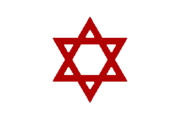
The Candar Flag has a red hexagram in its center.
Candar dynasty, also called Isfendiyar, had been a Turkmen dynasty (c. 1290–1461) that ruled in the Kastamonu-Sinop region of northern Anatolia (now in Turkey).
The dynasty took its name from Semseddin Yaman Candar, who served in the army of the Seljuq sultan Mas'ud II (reigned 1283–98) and was awarded the Eflani region, west of Kastamonu, in return for his services.

Karamanid Flag

Karamanid Flag hexagramPicture is courtesy of Wikipedia(Flag of Karaman according to the Catalan Atlas, c. 1375.
Karamanid Flag is very similar to the Israeli flag also in its color.
is a province of central Turkey. It was the location of the Karamanid emirate, which came to an end in 1486 after 250 years.

Beyond The Star 2

I already published a Picture of an iron gate in East Berlin with the same hole in the door in the shape of a Star of David "patent", and wrote that it is an original use of this shape. Now that there are two such doors I guess in the future I'll find and publish even more...
Picture is courtesy of "dM.nyc" who published it on Flickr.