Saturday, November 18, 2006

The Founders Of The Nation

The Founders Of The Nation Jewish StarThe following paragraph is from Dr. Asher Eder’s book The Star of David, which was published in 1987 in English in Jerusalem by Rubin Mass Ltd. The publication here is courtesy of Oren Mass
This version includes corrections and new materials that do not appear on the printed version
The double nature of David's struggles becomes even more obvious when we compare the term magen david with the term magen abraham5, the Shield of Abraham. True, the term magen refers in both cases to the Lord God.
The difference lies in the fact that Abraham received only the promise of the Land, and therefore had not actually been forced to fight for it (although, to be sure, he did not hesitate to engage in war in order to save Lot6), while David was forced into numerous wars in order to secure the country.
Consequently, the term magen abrahem has no corresponding graphic symbol; for God cannot be depicted by any image, not even by an abstract design. On the other hand, the Shield of David does not actually depict God, but rather the divine-human polarities in balance. In David's case, they include the land-people/God relationship.
An old Jewish tradition is worth mentioning here. King David asked why the Tanakh speaks of magen abraham, the Shield of Abraham, but does not mention the term magen david, the Shield of David? In the Divine answer, he was told that Abraham stood fast in all the temptations and trials while he, David, failed several times (as in his episode with Batsheva). Yet, while this was so, the Lord remained David's shield because of his penance.
King David's outstanding deed was the foundation of Zion - the balanced joining of the earthly and the heavenly under the sovereignty of the Creator. King David must have been aware that giving predominance to the earthly would result in mere nationalism, while overemphasizing the spiritual would pull the ground from under the people's feet.
So far, human history is indeed characterized by such ambivalence.
Throughout his life, David guarded this balance in his own person, restoring it by deep remorse and repentance whenever he disturbed it.
Being so human in all his affairs, he was at the same time extraordinary as psalmist, warrior, and statesman, so much so that in the Kabbalistic Tree, the sephirah malkuth (Kingdom) can be described by his nature.
David's aspiration to build the Sanctuary has yet another, even weightier implication. The Sanctuary is by nature the domain of the כהנים , the priests. By his readiness to hand it over to them, he relinquished in fact a big part of the power he would have had as an absolute ruler. His willingness to listen to priests and prophets is brought out several times in the Scriptures, the most known example being his acceptance of Prophet Nathan's rebuke. We may say that the Sanctuary served, besides its other functions, as a correcting agent in the nation's political system. Our graph, the hexagram, shows perfectly that this division of powers, indicated by the two triangles, results in harmony and unity if governed by the Lord God.
Although there is no historical or archeological evidence to prove that the six-pointed star was indeed David's monogram, the symbol shows the spirit of wholeness, and thus of holiness, as upheld by David.
There is one notable hint that the hexagram was known to David. The verses of seven of his Psalms are written in alphabetical order in the original Hebrew, and the themes of each reflect an order which follows a peculiar geometric pattern. The pattern of Psalm 145, perhaps most characteristic of David's thoughts, renders a perfect hexagram with a circle in its center.7
Taking all this into account, we can see now what David meant when he spoke of the Lord as his shield: a shield is immediately in front of whoever holds it. As he said (in Ps.16:8): "I have set the Lord always before me, for he is at my right [hand]. I will not be shaken."
However, David did not concentrate merely on God's protective power. The Lord was the content of David's life, so much so that he could give expression to this relationship in his songs of praise, where he describes Him by many exalting epithets, such as:


The Lord is my shepherd... (23:1);
the Lord is my fortress and refuge (18:3);
the Lord is my exaltation (59:17; 62:3);
the Lord is my strength (59:18; 62:8);
the Lord is my rock (18:3; 59:18; 62:8);
the Lord is my habitation (71:3);
the Lord is my portion (16:5; 73:26);
the Lord is my grace (144:2);
God is my exceeding joy (43:4).

This shows that the spirit of God was within and around David, guiding and protecting him like a suit of Divine armor. In this spirit, David "fought the battles of the Lord",8 and his men also kept themselves consecrated to God even when engaged in grim campaigns.9
Our symbol may also represent the founders of the nation: Abraham, Isaac, Jacob, Joseph, Moses, Aaron and David. While the first six contributed jointly to the people, it was David who united all these contributions in his founding of Zion. Consequently, he is called King of Israel.
Our graph, the hexagram, can be applied to different situations of our lives. E.g. in previous chapters we read that its middle field can depict the visible world; or the tribe of Levi; and others. In the above context, we may well attribute to it the establishment of the Kingdom by David, with the six other founders symbolized by the triangles around the middle field.
The idea expressed by this design corresponds with that expressed in the "Kabbalistic Tree" (see chapter 7).

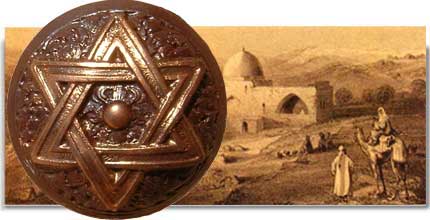
Magen David, The Shield Of David

Magen  David,  The  Shield  Of  David The following paragraph is from Dr. Asher Eder’s book The Star of David, which was published in 1987 in English in Jerusalem by Rubin Mass Ltd. The publication here is courtesy of Oren Mass
This version includes corrections and new materials that do not appear on the printed version
Many see the six-pointed Star as King David's personal monogram. They point out that the name David in Hebrew is דוד , daleth-wav-daleth, which can also be read "daleth & daleth" (as the letter wav can also mean "and"). In the old-Hebrew script, used from about the 10th to the 6th Century B.C.E., daleth had the form of a small triangle, similar to the old-Greek letter delta . The combination of the two daleth into a six-pointed star could well express David's achievement in uniting the Northern tribes of Israel (Joseph) with the Southern tribes of Judah (Yehudah)under their one God; or his great aspiration to unite the earthly and the heavenly under the Lord's sovereignty.
All this is underlined by the Hebrew name of the symbol: magen david, translated as "Shield of David" or "Star of David".
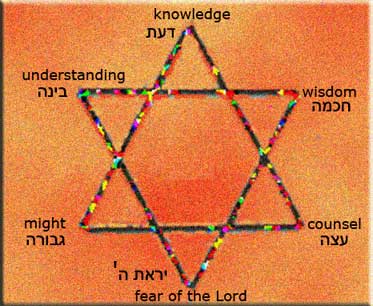
Jewish tradition holds that a six-pointed star was engraved on David's battle shield, and that the six outer triangles represented the six aspects of the Lord's spirit: "the spirit of wisdom and understanding, the spirit of counsel and might, the spirit of knowledge and of the fear of the Lord".
An old Arab tradition, probably deriving from this, says David's battle shield itself was in the shape of a six-pointed star.
The deeper inner meaning of these traditions is that David, both in his personal and in his national struggles "set the Lord always before him", and was shielded by Him even when he failed. Correspondingly, David's weapons in securing the country included both the Divine virtues and the sword of battle.

Jerusalem / Zion

The following paragraph is from Dr. Asher Eder’s book The Star of David, which was published in 1987 in English in Jerusalem by Rubin Mass Ltd. The publication here is courtesy of Oren Mass

This version includes corrections and new materials that do not appear on the printed version

Photo is courtesy of mharrsch who Photographed it at "The Holy Land Experience", Orlando, Florida and published it on Flickr.

The story of this most historic city begins in the days of Melchizedek, King of Salem, a priest of God the Most High, who according to Jewish tradition, was none other than Shem (Sem)1, one of the sons of Noah. Salem, now called Yerushalayim (Jerusalem), is the place where Abram-Abraham met Melchizedek.2
Since these remote days, Jerusalem became a focus for Abraham's descendants, and a counteragent to Babel. Yet there is more to it.
King David, following this Abrahamic tradition, confirmed Jerusalem as the city of acknowledgment and proclamation of the Lord as King over Israel and all nations.
We will better comprehend this proclamation when we realize the significance of Jerusalem’s geographical position. It is located right on top of a north-south stretching mountain range whose western slopes get good winter rain, and are fertile land for farmers, while its rather arid eastern slopes carry the shepherds with their flocks. The territory of the tribe of Yehudah comprises both parts; for, as the ruling tribe, he has also to balance the diverging interests of the farming and the shepherding societies and the respective cultures which they developed (Cain and Abel at the beginning of mankind’s history; and in our present situation, Christianity in the west and north of Jerusalem, and Islam in its east and south); and to establish peace based upon the Divine Law.
Thus, Jerusalem is indeed the apex of the Divine work of guiding and educating Mankind. The proper celebration of the Divine sovereignty on Earth is the main thrust to David's Psalms and of the teaching of the Prophets who came after him.
King Solomon, continuing his father's endeavors, built the Temple in Jerusalem as the House of the Lord, the visible dwelling place of His Name.3
Since the days of David and Solomon, Jerusalem has also been called the "City of the Sanctuary"4 or "Zion".5 These names imply that the earthly Jerusalem is the irrevocable and indissoluble base for the Heavenly Jerusalem. It is so for the benefit of all mankind.
This is strikingly transfigured in Jerusalem's topography, too. "Earthly" Jerusalem started out next to the Gihon spring at the lowest point of the whole area. It was built upon a small hill between the Kidron Valley6 and the Tyropean Valley (now nearly filled with rubble). This hill contained the "City of David", as Jerusalem was called after David's conquest.7 In fact, it is a protrusion (or ophel in Hebrew) coming forth from Mount Moriah. Geographically and geologically, Mount Moriah (also known as the Temple Mount) and the City of David form one unit, with the latter as the lower and the Temple Mount as the upper part. Figure 50a shows the topographical lines of the area; figure 50b, the walled City of David with the Temple Mount in the background, as can be seen in the 1:50 scale model outside the Holy Land Hotel (West), Jerusalem:

Friday, November 17, 2006

Israel and the Nations

Israel  and  the  Nations Magen DavidThe following paragraph is from Dr. Asher Eder’s book The Star of David, which was published in 1987 in English in Jerusalem by Rubin Mass Ltd. The publication here is courtesy of Oren Mass
This version includes corrections and new materials that do not appear on the printed version
Israel, in many ways a nation (goy) like other nations, has been "chosen" and set apart for a special task. This makes it appear in the eyes of the world as separate from it, "dwelling alone, and...not to be reckoned among the nations", as the Gentile seer Balaam put it.
Israel does not separate itself out of self-conceit, as some would have it; its peculiarity is a natural result of the Divine Covenant which was made with the Jews, with its special commandments congenial to its priestly service.
Let us not forget that it was Nimrod who deviated from the order set by Noah, and that by founding Babel he tried to do away with Shem and 'Eber and the Divine teaching they represented. Thus Abraham's exodus from Babel was a necessary step in the process of healing the world.
Within the healing process, Israel is called a "kingdom of priests, and a holy nation." That is to say, Israel fulfills a priestly role for the rest of the world. Since this service is on behalf of the Holy One ("Blessed be His Name"), Israel is also called goy kadosh, "people of the Holy" or "holy people". So the Name of the Lord (Shem) is laid upon Israel, and the Jews pass through history as bearers of the Name, or Semites - visible witnesses to the Divine Covenant.
Neither the Israelites' transgression of the commandments nor their blindness can dissolve the Covenant or annul their priestly position. Only assimilation with other cultures can bring it to naught, as we learn from the fate of the "Ten Lost Tribes" of the Northern Kingdom. They turned away from Jerusalem, built their own sanctuaries, adopted foreign ideologies and practices and disappeared shortly after their deportation by the Assyrians, when they mingled with other nations.
The danger of assimilation was indeed a main concern of the prophets, as reflected in their numerous warnings. In the course of history, the Israelites withstood many attempts to undermine the Covenant which God made with them. Such attempts sometimes came from inside the nation, sometimes from outside, as for instance when Hamor the Sichemite suggested that the children of Israel join with his people. Other examples include the cunning device of, modern missionary practices, and the attempt to tear the Temple Mount and other parts of the ancient homeland away from the Jews (a striking description of such an attempt is found in Psalm 83:3-11
In this context, it should be stressed that Israel is not only a congregation in the religious sense, as are Catholics and Protestants. It is also a specific nation tied to a specific land, with all the attendant consequences, such as the need to develop, administer and defend the country. Israel is not meant to remain aloof from the world; on the contrary, it has to partake fully of it, but without adopting the world's mindset. Nor is Israel meant to preach morality to other nations. Rather, it must teach by example, and work out all the human problems within its own family in the light of the Divine Teaching. To live in the country is, from this perspective, vital for the people's self-fulfillment, and to the healing of the world.
This, "the Holy Land", is for the Jews "the Land of the Sanctuary", "the Land of the Moriah" and "the Land of the Hebrews". These terms serve to identify us as we call for self-fulfillment, thereby providing a foundation for much of Israel's priestly function. It is for this reason that the country was allotted to the people of Israel as an everlasting inheritance from the Lord of the Covenant. Within the framework of its priestly function, Israel's three descents into the world - first Egypt, then Babylonia and now the entire planet - and its subsequent ascents back to the Land of the Fathers, the Torah and the Prophets, are highly important, as they bear witness to God's Hand in history. This ongoing revelation of Divine will is what actually gives meaning and direction to history, which would otherwise appear as a chain of random events, or as another example of the stronger eating the weaker. Moreover, it sets God's existence and might before the eyes of the world.
Thus, Israel's return to the Land of the Fathers should never be reviled as invasion. It rather merits the explanation given by Prophet Jeremiah, who was appointed a prophet to the nations (1:4):
"Hear the word of the Lord, O ye nations,
and declare it [even] in the islands far off,
and say He who scattered Israel will gather
him and keep him, as a shepherd does
his flock... therefore they shall come and
rejoice in the height of Zion." (ch.31:10)

The intention is that Mankind come to recognize its true Lord and Creator, and acknowledge His laws in the physical as well as in the psychic and spiritual realms, in order to "serve Him in one consent" for the sake of peace and for the welfare of all. Knowledge of the Lord goes in tandem with peace and welfare. It is to this end that "the Name of the Lord shall become known to all nations."
To speak in terms of our symbol, Israel, the bearer of the Divine Name, may well be represented by one triangle, and the nations by the other. Both should join into the harmonious six-pointed Star, centered in the One who is Lord over all.

Thursday, November 16, 2006

Star of David Chocolate

Star of David Chocolate
Picture is courtesy of Jeanne Fleming, aka chocolate Devi,
Jeanne, together with Jessica Bard is sculpting chocolates by order. One of the designs they offer their customers is a Star of David Chocolate and there’s a special section on their website that tells very gracefully the story of this symbol. Here’s my favorite excerpt:
Story has it that the Star was emblazoned on the Shield that David, the future King of Israel, used when, as a boy, he went up against the giant Goliath on the battlefield in the Valley Elah. But, everyone who knows that story also knows that David defeated the Giant with no protection–he just had his sling shot and his faith. Of course, that is where the shield really does come in. His shield was not a physical object bearing an insignia–his shield was his faith.

From another section, which explains the philosophy behind all this I understood that the Star of David belongs to a family of symbols of:
Love and luxury, joy and happiness, compassion, peace and serenity, healing, and fertility of the body and imagination

Mezuzah

There are many Mezuzah's with Stars of David on them. My hunch is that the reason for this is that they are both protecting their owners. The Mezuzah protects the doors of the house - if one letter is damaged people believe it might bring bad luck. Star of David is also known as a shield that protects from evel eye.
Picture is courtesy of "twohorses" who published it on Flickr.

The Formation Of Israel

The  Formation  Of  Israel tribes Magen DavidThe following paragraph is from Dr. Asher Eder’s book The Star of David, which was published in 1987 in English in Jerusalem by Rubin Mass Ltd. The publication here is courtesy of Oren Mass
This version includes corrections and new materials that do not appear on the printed version
While the biblical story of Abram leaving Babel and becoming Abraham, "father of a multitude of the faithful", is popular, its background is less known. A closer study will help us understand the position of Israel within the Family of Man, and in this context, the meaning of its symbol, the six-pointed Star of David.
Noah set a certain order for Mankind after the Flood, with his three sons Shem, Ham, and Japhet. They are the ancestors of the different nations and tribes, but also represent three basic human aspects; spirit, emotion and intellect.
One of the descendants of Shem (meaning name, spiritual principle) was called 'Eber, עבר, which describes one who lives his life according to the principles of Shem, bearer of the Divine Name. A contemporary of 'Eber, a descendant of Ham (meaning warmth, emotional principle) was called Nimrod, which means "let us revolt". His revolt, appealing to men's egos and to their respective desires to unite, was directed against Shem, the bearer of the Divine Name and ancestor of the priestly tribe among his brethren, and against 'Eber, ancestor of the Hebrews. In the wake of his revolt, Nimrod founded the Kingdom of Babel, the Babylonian name of which, Babel, means God's door. The very name of his kingdom thus proclaimed Nimrod's boast of direct access to God, without Shem or 'Eber, and the qualities they represented. This idea is expressed in Babel's motto: "Come, let us build us a city and a tower whose top (head) will be in heaven, and let us make unto us a name...", thus replacing God's Name by their own, and attempting to usurp His Kingdom.
But such wrong-headed, ego-based doctrines, theologies and ideologies, once established as life principles, seduce their followers into performing actions which are right and just in their own eyes but unright and unjust in God's eyes, leading to a collision with His Laws and with one another, and inevitably then with the people bearing His Name.
Nimrod's attempt to found his own spiritual kingdom caused the splitting up of the world - a fact which 'Eber marked by calling one of his sons Peleg ("For in his days was the earth divided"). This split, however, did not occur only between Shem and 'Eber, on the one side, and Nimrod's followers on the other. The latter were, and still are, split and divided amongst themselves.
We should not think that this division occurred as the result of some cruel curse of an extraterrestrial origin. It is, quite naturally, a direct consequence of putting up gods instead of the One God, of establishing ideals that are either deified natural forces, or simply reflections of their inventors' egos, often in the garb of religions. Since neither of them is an absolute authority, different people express their understanding and opinions about them in different ways, and ultimately go in separate directions, vying, quarreling, confused and confusing others.
Abram recognized the futility of Babel's undertakings. He was the first to answer the Divine call: he left Babel, and the Lord God established the Covenant with him. So begins Israel's history.
In the unfolding of this history, we read in Gen.17:5 that Abram's name was changed into Abraham by inserting the sign ה , heh, in his original name, as mentioned. Likewise Sarai's name was changed into Sarah, by replacing the sign ,י yod, with ,ה heh.

,הheh, stands for the Divine attributes of Grace and Mercy; at the end of a word, it also indicates inclination or direction. Abraham, the key Biblical figure for Mankind after the Flood, is characterized by that sign, and so are Sarah his wife, and Yehudah, the main tribe of the people of Israel.
Right from its start, Israel was called to be ,עם סגולהa peculiar people (Exod.19:5). Merely leaving Babel, or Egypt later on, does not yet form Israel into something particular or peculiar. For instance, Assyria, too, left Babel, but it did not become a peculiar people. In Israel's case, it is the going towards Mount Sinai and into the land of promise which gives this leaving of Babel and of Egypt a positive and unique turn. Without this turn it would not be much different from any other nation.
A crucial expression of this turn we find in the tribe of Levi and what it stands for. To better understand this, let us look into the composition of Israel. As known, Israel is made up of the twelve sons of its Patriarch Jacob (Gen.35:22). The number twelve of these tribes could relate to the twelve signs of the Zodiac and the fullness of the material world it represents. This does not make Israel into something peculiar either. Many other nations relate to this fullness, and even Ishmael is mentioned as being headed by twelve princes (Gen.17:20; 25:16), without becoming a peculiar people. Israel is not meant to subjugate to the power of the Zodiac and the material world it stands for; rather Israel is called to be faithful to the Lord God Creator of all by adhering to the special commandments given through Moses on Mount Sinai (cf. Exod.19:5; Levit.11:43-45; Deut.28:5, and many others).
Moses, as known, came from the very tribe of Levi who was singled out for the priestly service among the people of Israel. While Levi, due to his priestly destination, was exempted from inheriting a particular part of the land, families of this tribe were distributed among the other tribes of Israel to serve there during the time they were not engaged in the temple service.
Exempting Levi from the land allocations, would mean to reduce the number of the land-inheriting tribes from twelve to eleven. This deficiency was balanced by branching the tree of Joseph into two tribes, namely his sons Ephraim and Manasse. By allotting land to them, in accordance with Jacob's special blessing over them, the number twelve remained in force. Consequently, Levi is part of all of them and via them of the land as well, and on the other hand is consecrated fully to its priestly service without being tied to a specific territory.
Levi's significance and his position between the tribes were brought out in a very peculiar way when they were ordered, after entering the country, to single out six of them who had to go up Mount Gerizim to proclaim from there the blessings, while the remaining six had to go up Mount Ebal to proclaim the curses upon those who would transgress the commandments, while the tribe of Levi was positioned in the valley between these two hills. To be more accurate on this latter point, it is not the whole tribe of Levi who occupies the middle field but rather those of that tribe who happened to be on active duty as Cohanim (priests) or Levites.9 Indeed, Levi is also mentioned as one of the tribes who had to go up Mt.Gerizim, while both Ephraim and Manasse came in this instance not as two tribes but as one tribe, Joseph. This is to show us that Levi, although being the priestly tribe, was not neither detached from the land, nor outside the people. He did not inherit a territory similar to the other tribes, rather the Levite families got lands (kind of small holdings) in the territories of the other tribes where they lived, and worked, while not on duty.
What is said here about the tribe of Levi, holds similarly true for the people of Israel in its position as the “Kingdom of Priests” among the nations.
Our hexagram allows, or even calls, for demonstrating this peculiarity in a very beautiful way. We can put the names of the six tribes who were on Mount Gerizim next to the six corners of the hexagram, and the names of the six other tribes into the six ankles, while Levi – those who served - would come into the middle field. This would point out Israel's peculiarity graphically more than anything else:
Summing up Israel's position and task, based upon the Divine teaching, Mal.2:7 says:
"The priest's lips keep knowledge,
and they seek the law at His mouth;
for he is the messenger
of the Lord of hosts."
Without Levi, Israel or any of its tribes would be like any other nation; while Levi without Israel would be like a sect. It is this intrinsic togetherness of Israel's tribes, including Levi, which makes up for her peculiarity.
It is in this peculiarity that Israel serves as the ,ממלכת כהנים kingdom of priests, for the rest of Mankind, irrespective whether in exile or settled in the Land. While in exile, its priestly function and service are partial, and truncated..

Dr. Eder's notes:
The Babylonian word Bab-El comes down in Hebrew to ba-bel, which can either mean "with Bel" (name of the Babylonian deity, Jer.50:2; 51:44), or "with nothing".

Jewish oral tradition says of the citizens of Babel that when building their tower, they didn't care if one of their laborers fell to his death, but if one of the expensive bricks broke, they would put the person responsible to death. This simple story shows that they put material values before the life of human beings.

Entreaty, pushing forward one's own ego, is called idolatry, cf. 1.Sam.15:23.

Assyria left Babel, too. Joining neither Babel, nor Abraham, it looked for a “Third Way”, and build Niniveh, Gen. 10:11. Since there is no third way, ,Assyria became as hostile to Israel as was Babel. “Whosoever is not with us will be against us”, is a true saying, and has been proven throughout the millennia.