Thursday, November 16, 2006

The Formation Of Israel

The  Formation  Of  Israel tribes Magen DavidThe following paragraph is from Dr. Asher Eder’s book The Star of David, which was published in 1987 in English in Jerusalem by Rubin Mass Ltd. The publication here is courtesy of Oren Mass
This version includes corrections and new materials that do not appear on the printed version
While the biblical story of Abram leaving Babel and becoming Abraham, "father of a multitude of the faithful", is popular, its background is less known. A closer study will help us understand the position of Israel within the Family of Man, and in this context, the meaning of its symbol, the six-pointed Star of David.
Noah set a certain order for Mankind after the Flood, with his three sons Shem, Ham, and Japhet. They are the ancestors of the different nations and tribes, but also represent three basic human aspects; spirit, emotion and intellect.
One of the descendants of Shem (meaning name, spiritual principle) was called 'Eber, עבר, which describes one who lives his life according to the principles of Shem, bearer of the Divine Name. A contemporary of 'Eber, a descendant of Ham (meaning warmth, emotional principle) was called Nimrod, which means "let us revolt". His revolt, appealing to men's egos and to their respective desires to unite, was directed against Shem, the bearer of the Divine Name and ancestor of the priestly tribe among his brethren, and against 'Eber, ancestor of the Hebrews. In the wake of his revolt, Nimrod founded the Kingdom of Babel, the Babylonian name of which, Babel, means God's door. The very name of his kingdom thus proclaimed Nimrod's boast of direct access to God, without Shem or 'Eber, and the qualities they represented. This idea is expressed in Babel's motto: "Come, let us build us a city and a tower whose top (head) will be in heaven, and let us make unto us a name...", thus replacing God's Name by their own, and attempting to usurp His Kingdom.
But such wrong-headed, ego-based doctrines, theologies and ideologies, once established as life principles, seduce their followers into performing actions which are right and just in their own eyes but unright and unjust in God's eyes, leading to a collision with His Laws and with one another, and inevitably then with the people bearing His Name.
Nimrod's attempt to found his own spiritual kingdom caused the splitting up of the world - a fact which 'Eber marked by calling one of his sons Peleg ("For in his days was the earth divided"). This split, however, did not occur only between Shem and 'Eber, on the one side, and Nimrod's followers on the other. The latter were, and still are, split and divided amongst themselves.
We should not think that this division occurred as the result of some cruel curse of an extraterrestrial origin. It is, quite naturally, a direct consequence of putting up gods instead of the One God, of establishing ideals that are either deified natural forces, or simply reflections of their inventors' egos, often in the garb of religions. Since neither of them is an absolute authority, different people express their understanding and opinions about them in different ways, and ultimately go in separate directions, vying, quarreling, confused and confusing others.
Abram recognized the futility of Babel's undertakings. He was the first to answer the Divine call: he left Babel, and the Lord God established the Covenant with him. So begins Israel's history.
In the unfolding of this history, we read in Gen.17:5 that Abram's name was changed into Abraham by inserting the sign ה , heh, in his original name, as mentioned. Likewise Sarai's name was changed into Sarah, by replacing the sign ,י yod, with ,ה heh.

,הheh, stands for the Divine attributes of Grace and Mercy; at the end of a word, it also indicates inclination or direction. Abraham, the key Biblical figure for Mankind after the Flood, is characterized by that sign, and so are Sarah his wife, and Yehudah, the main tribe of the people of Israel.
Right from its start, Israel was called to be ,עם סגולהa peculiar people (Exod.19:5). Merely leaving Babel, or Egypt later on, does not yet form Israel into something particular or peculiar. For instance, Assyria, too, left Babel, but it did not become a peculiar people. In Israel's case, it is the going towards Mount Sinai and into the land of promise which gives this leaving of Babel and of Egypt a positive and unique turn. Without this turn it would not be much different from any other nation.
A crucial expression of this turn we find in the tribe of Levi and what it stands for. To better understand this, let us look into the composition of Israel. As known, Israel is made up of the twelve sons of its Patriarch Jacob (Gen.35:22). The number twelve of these tribes could relate to the twelve signs of the Zodiac and the fullness of the material world it represents. This does not make Israel into something peculiar either. Many other nations relate to this fullness, and even Ishmael is mentioned as being headed by twelve princes (Gen.17:20; 25:16), without becoming a peculiar people. Israel is not meant to subjugate to the power of the Zodiac and the material world it stands for; rather Israel is called to be faithful to the Lord God Creator of all by adhering to the special commandments given through Moses on Mount Sinai (cf. Exod.19:5; Levit.11:43-45; Deut.28:5, and many others).
Moses, as known, came from the very tribe of Levi who was singled out for the priestly service among the people of Israel. While Levi, due to his priestly destination, was exempted from inheriting a particular part of the land, families of this tribe were distributed among the other tribes of Israel to serve there during the time they were not engaged in the temple service.
Exempting Levi from the land allocations, would mean to reduce the number of the land-inheriting tribes from twelve to eleven. This deficiency was balanced by branching the tree of Joseph into two tribes, namely his sons Ephraim and Manasse. By allotting land to them, in accordance with Jacob's special blessing over them, the number twelve remained in force. Consequently, Levi is part of all of them and via them of the land as well, and on the other hand is consecrated fully to its priestly service without being tied to a specific territory.
Levi's significance and his position between the tribes were brought out in a very peculiar way when they were ordered, after entering the country, to single out six of them who had to go up Mount Gerizim to proclaim from there the blessings, while the remaining six had to go up Mount Ebal to proclaim the curses upon those who would transgress the commandments, while the tribe of Levi was positioned in the valley between these two hills. To be more accurate on this latter point, it is not the whole tribe of Levi who occupies the middle field but rather those of that tribe who happened to be on active duty as Cohanim (priests) or Levites.9 Indeed, Levi is also mentioned as one of the tribes who had to go up Mt.Gerizim, while both Ephraim and Manasse came in this instance not as two tribes but as one tribe, Joseph. This is to show us that Levi, although being the priestly tribe, was not neither detached from the land, nor outside the people. He did not inherit a territory similar to the other tribes, rather the Levite families got lands (kind of small holdings) in the territories of the other tribes where they lived, and worked, while not on duty.
What is said here about the tribe of Levi, holds similarly true for the people of Israel in its position as the “Kingdom of Priests” among the nations.
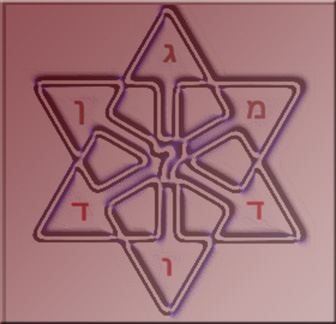
Our hexagram allows, or even calls, for demonstrating this peculiarity in a very beautiful way. We can put the names of the six tribes who were on Mount Gerizim next to the six corners of the hexagram, and the names of the six other tribes into the six ankles, while Levi – those who served - would come into the middle field. This would point out Israel's peculiarity graphically more than anything else:
Summing up Israel's position and task, based upon the Divine teaching, Mal.2:7 says:
"The priest's lips keep knowledge,
and they seek the law at His mouth;
for he is the messenger
of the Lord of hosts."
Without Levi, Israel or any of its tribes would be like any other nation; while Levi without Israel would be like a sect. It is this intrinsic togetherness of Israel's tribes, including Levi, which makes up for her peculiarity.
It is in this peculiarity that Israel serves as the ,ממלכת כהנים kingdom of priests, for the rest of Mankind, irrespective whether in exile or settled in the Land. While in exile, its priestly function and service are partial, and truncated..

Dr. Eder's notes:
The Babylonian word Bab-El comes down in Hebrew to ba-bel, which can either mean "with Bel" (name of the Babylonian deity, Jer.50:2; 51:44), or "with nothing".

Jewish oral tradition says of the citizens of Babel that when building their tower, they didn't care if one of their laborers fell to his death, but if one of the expensive bricks broke, they would put the person responsible to death. This simple story shows that they put material values before the life of human beings.

Entreaty, pushing forward one's own ego, is called idolatry, cf. 1.Sam.15:23.

Assyria left Babel, too. Joining neither Babel, nor Abraham, it looked for a “Third Way”, and build Niniveh, Gen. 10:11. Since there is no third way, ,Assyria became as hostile to Israel as was Babel. “Whosoever is not with us will be against us”, is a true saying, and has been proven throughout the millennia.

Wednesday, November 15, 2006

The Sign Aleph

The Sign Aleph Hebrew letter
The following paragraph is from Dr. Asher Eder’s book The Star of David, which was published in 1987 in English in Jerusalem by Rubin Mass Ltd. The publication here is courtesy of Oren Mass
This version includes corrections and new materials that do not appear on the printed version
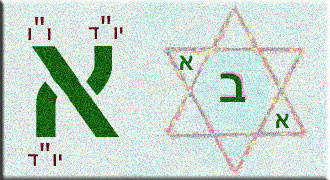
The diagonal placing of the signs of the word ,אבא abba, in our Star is configured in the sign ,א aleph, itself. If we look at this closely, we see that אis in fact a combination of two Hebrew signs, namely ,וwav, and , י yod (Yota, in Greek), represented twice.
Yod stands for hand, or, as often as not, God's Hand everywhere, so to speak. It is a component of each of the 22 signs (otiot, letters in the Aleph-Beth), indicating that God's Might and Presence are manifest everywhere, whether we notice it or not.
Wavו ,, means hook - on which everything hangs. It is also the sign for the word "and". Symbolically, it stands for the integral man, to whom God entrusted His creation so that we may have dominion over it - in the image of our Creator, and not as a destroyer. Man with his double nature - physical body and spiritual soul - was created for this purpose, and it is he, and only he, who consciously and at will can and should link the material with the spiritual. As the Psalmist says: "Thou [God] hast given him [Man] dominion over the works of thy hands; thou hast put all things under his feet,"
However, in the sign aleph, the wav is not vertical, but occupies a diagonal position. This indicates that Man is in an ongoing process of growth. In this process, he finds himself with God's might hovering over him, as symbolized in א by the ,יyod, right side above; and the Divine spark within him, as symbolized by the ,י yod, left side below. Yet, we can see that the yod below is not exactly the same as the yod above. Maybe this is to remind us that the Divine spark in Man, though in its essence identical with the Creator, is not the Creator Himself.
A drop of water from the ocean is in essence identical with its source, yet it is not the ocean. So the Divine in us is far from being God. Created after His image and likeness, we can take part in His Creation, as co-creators, although without the power to create ex nihilo.
,א aleph, thus symbolizes God's creative spirit both before its manifestation in Creation, and in its manifestation, especially in Man. It is this spirit which raises Man from the animal state to that of true humanity. The Hebrew language brings this out in a beautiful way. It forms the word ,אדםadam, meaning Man or Mankind, by placing the sign ,אaleph, before the word,דם dam, which means blood. Thus , אדם adam , designates a living being of flesh and blood and linked to, and governed by, the spirit of God.


Dr Eder's notes to this chapter:

Interestingly enough, the numerical value of these components of א , aleph, is 26, like that of the tetragrammaton; v. Aryeh Kaplan, Meditation and the Bible, p.82 (Samuel Weiser, Inc; York Beach, Maine, 1978, ISBN 0-87728-364-8).

The Biblical term "let us make Man..." in Genesis 1:27 does not allude to a trinity or other plurality of God; it indicates that the "hosts of heavens" (including the sun, moon, and stars, v. Gen.2:1; Deut.4:19; 17:3) play a role in the process of "Man Making" (see notes 6 of chapter 7, and 8 of chapter 8). God did not say "let me make Man", or "I'll make Man". That would have reduced Man to a passive animal, which at most could be trained for specific limited work. Therefore, we are told: "Be not like a horse or mule, devoid of understanding, bit and bridle their ornaments..." (Ps.32:9).
As true humans, we are "made a little less than God", as said in Ps.8:6

Six Letters

Six Letters Magen DavidI made this Photoshop design in order to illustrate why the Star of David has six triangles - in Hebrew it is called Magen David and has six letters, each demands its own triangle. Of course in English, where it is called star of David you need more triangles to satisfy this demand...

Jewish Agency

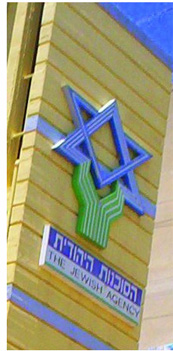
Jewish Agency Magen DavidOne of the most famous Stars of David appears on the logo of the Jewish Agency. Photo is courtesy of Brer Rabbi who published it on Flickr. 

Tuesday, November 14, 2006

The Sign Daleth

The  Sign  Daleth Hebrew letter
The following paragraph is from Dr. Asher Eder’s book The Star of David, which was published in 1987 in English in Jerusalem by Rubin Mass Ltd. The publication here is courtesy of Oren Mass
This version includes corrections and new materials that do not appear on the printed version

Daleth, ד , means door. It is any door's function to allow passage or to block it. If one wants to enter a house or move from one room to another, one has to pass through a door. This simple truth also holds when considering Man's way from the "natural, earthly Adam" to the "spiritual Adam" (see above, chapters 7 & 8).
Abram-Abraham followed the Divine call to leave Babel. He opened the door into God's Kingdom. This opening of the door meant for him and his seed after him a one-way passage, and a simultaneous closing of that door to prevent a return to Babel It is for this passing that he was called a Hebrew which means literally "one who passed, or crossed", i.e. who crossed from the world of Babel into the true world of the spirit of God. Abraham, being a physical descendant of 'Eber', by this act of passing became his spiritual son as well, worthy of that name (‘Eber = Hebrew, in English).
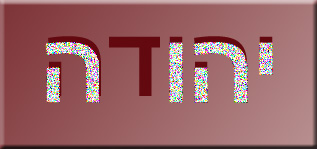
Abraham's role, after the split of David's kingdom and the disappearance of the Northern Kingdom of Israel, is being carried on by the tribe of Yehudah (Juda, in English transcript). This name is formed by inserting ד, daleth, the fourth sign of the Hebrew Aleph-Beth, into the tetragrammaton, the Name of the Lord. That means to say that the name of this tribe, Yehudah, already indicates its task of "opening a door" into God's kingdom, and uniting the four worlds, under His sovereignty.
However, all this traces back to Abraham. With him begins the history of Israel which is to lead into the Divine Kingdom, the latter being symbolized by the fifth sign of the Hebrew Aleph-Beth, i.e ,ה heh.
The insertion of this sign into his original name Avram and converting it to Avraham (Abraham in English transcript) points to that mission of his.

Dr. Eder's notes:
A man who does not harken to the call unto his freedom, is symbolically brought to the door, and his ear is bored, Exod. 21:5,6. Significantly enough, the rule to free slaves tops the list of commandments right after the Decalogue.

'Eber, in Gen.10:24, 11:14-16, is the English transcript for the Hebrew word 'ever, which means Hebrew, i.e. one who crossed from the world of confusion to the Divine Kingdom of Truth. The crossing of the Jordan River from the lands of Babel expresses this geographically. 'Eber is the prototype of the Hebrews, this term being confined to the line of Abraham-Isaac-Jacob and their descendants who are known as the Semites. Cf. Exod.7:10, Num.6:27, Deut.28:10.

The English spelling for the word Yehudah is Judah or Jew. Yehudah means literally "he will confess, or thank, God if even only by his very being."

The letter u in the English spelling Yehudah derives from the Hebrew sign wav, which can be rendered by o, u, or v, depending on its position in a word.

We may say that Yehudah is God's answer to Nimrod's Babel.

The "Four Worlds" of Emanation, Creation, Formation and Making, are expressed in the "Kabbalistic Tree"; see Adam and the Kabbalistic Tree, by Z'ev ben Shimon Halevi, p.28.

The role of the sign ה , heh, and what it symbolizes, is indicated by its insertion into the name אברם , Abram, thus forming אברהם , Abraham , Gen.17:5). There are scholars who trace its importance back to the term בהבראם , bi'hibaram of Gen.2:4: "when they [i.e. Heavens and Earth] were created." This Hebrew term allows the interpretation "in (or with) ה , heh, created He them." Moreover, the term הבראם contains the same signs by which the name ,אברהם Abraham, is composed, suggesting that with it, or with Abraham, will the Lord make (עשה) Earth and Heavens. Some scholars find this idea emphasized in the Torah by the writing of the sign ה there at half its normal size. This small format may tell us about the small beginning, the Divine idea, which then takes shape in, or with, Abraham, expanding into Israel, and finally reaching out to Mankind. Thus ה, heh, may be seen as a symbol for the Divine Kingdom.

The Sign Gimel

The  Sign  Gimel Hebrew letterThe following paragraph is from Dr. Asher Eder’s book The Star of David, which was published in 1987 in English in Jerusalem by Rubin Mass Ltd. The publication here is courtesy of Oren Mass

This version includes corrections and new materials that do not appear on the printed version
If deprived of its upper yod, aleph not only loses its completeness, it changes into gimel, the third sign of the Hebrew Aleph-Beth
Gimel is the sign for camel (,גמל gamal in Hebrew), whose home is in the desert. The camel has the intelligence to get on well there, and to find nourishing oases. But it is not the Garden of Eden.
We may compare this "camel-like" state to the middle field of our Star without its six surrounding triangles. It would look rather meaningless and dreary, its outline being that of a cell in a honeycomb, which may symbolize the highly intelligent yet monotonous life in a beehive (or in a soulless technocracy)
If we look more closely at ,גgimel, and compare it with ,א aleph, we will note that its lower yod is smaller than that of aleph, while its wav straightens its head as if attempting to replace the missing upper yod. We can perceive this as a symbol of Nimrod's Babel. True, even ancient Babel tried to practice mutual charity ( ,גמילותgemiluth) to quite some degree, and knew about God's punishment for not practicing it; yet everything ended in confusion because of the denial of Shem, symbolized by the missing upper yod.
Just as gimel is not the last sign of the Hebrew Aleph-Beth, so is Babel neither the aim nor the end of human history. Our sages say that the sign ג, gimel, looks like a man running toward the next sign, or letter, in the Hebrew aleph beth, ד:

The Sign Beth

The  Sign  Beth Hebrew letterThe following paragraph is from Dr. Asher Eder’s book The Star of David, which was published in 1987 in English in Jerusalem by Rubin Mass Ltd. The publication here is courtesy of Oren Mass
This version includes corrections and new materials that do not appear on the printed version.
As we said earlier, ,בbeth, means house, as for instance in the name Bethlehem, House of Bread. It can also stand for the whole Creation, the House the Creator provided for us. The Tanakh begins with this letter, and the question was raised: why does ,בbeth, and not ,אaleph, denote the beginning of Creation? A striking answer is that the Tanakh does not deal with theological arguments or speculations about God; it deals instead with God's laws and instructions for Man on this Earth as our "house".
The very design of the letter alludes to this idea; it opens in one direction only, namely the direction in which Hebrew is written, Hebrew being the language "by whose letters (signs, characters) and their combinations God created the world." This indicates that the whole Scripture is Torah, Divine Instruction given by the Creator from beyond ,ב beth, and directed at Man, who dwells in beth. ב