Saturday, November 11, 2006

Old-New Synagogue Window, Prague


Picture of Magen David on the Old-New Synagogue Window of Prague is courtesy of "MindSpigot" who published it on Flickr.
The following paragraph is from Dr. Asher Eder’s book The Star of David, which was published in 1987 in English in Jerusalem by Rubin Mass Ltd. The publication here is courtesy of Oren Mass. This version includes corrections and new materials that do not appear on the printed version

What is more, also synagogues began now to show the hexagram, one in Hameln/Germany, and the famous Altneuschul in Prague, both built at the end of the 13th century.
Before going more into details about the latter, we should have a brief look into the historic context, that is, into the social atmosphere of then.
Christian anti-Semitism which got codified and legalized by Emperor Justinian in the 6th century, turned violent with the Crusades. The slaughter of Jews in France and Germany, and then in Jerusalem, are known. With the defeat of the Crusaders and the loss of Jerusalem, Christianity got a new trend altogether: “Earthly Jerusalem” was replaced by the idea of “Heavenly Jerusalem”. This idea found its architectural expression in the Gothic style of the cathedrals and churches, with the high extension of its pointed arches symbolizing the propensity heavenwards, and its raising towers with their tops in heaven. Within this trend, the Fourth Lateran Council of 1215 decreed that the Jews (and Saracenes) have henceforth to wear clothing which makes also a visible distinction between them and the Christians. The governments (as the “sword hand” of the Holy Sea) were to make regulations about specific dresses and the wearing of the “Jew badge” legal (this was done e.g. in the “Book of Laws” compiled by Alfonso X of Castile (1252-82); by Edward I of England in 1275; by Alfonso IV of Portugal in 1325). These badges, to be fixed on the hat or upon the chest, were mostly round, red or yellow in color, but there were also other signs of differentiation – e.g. the horned Jew hat; specified colors of the dresses; and indeed also badges in form of the hexagram. A royal decree, issued during the anti-Jewish riots in Spain at the end of the 14th century, forced Jews to wear a “red star with six points”, and a painting by Nuno Goncalves, now in the altar piece of St.Vincent/Portugal, shows such a six-pointed red star on the robe of the chief rabbi of Portugal, just over the heart.
Within the frame of these historic developments, we should have now a closer look into the key role the above mentioned Altneuschul of Prague was to play in the slow transition of the hexagram from a random sign to a symbol of the Jewish people.
Built at the 13th century in the early Gothic style of then, it shows rosette-like hexagrams in its two round front windows.

Thou Shalt Love Thy Neighbor

Thou Shalt Love Thy Neighbor
The following paragraph is from Dr. Asher Eder’s book The Star of David, which was published in 1987 in English in Jerusalem by Rubin Mass Ltd. The publication here is courtesy of Oren Mass
This version includes corrections and new materials that do not appear on the printed version
Men often think that, in order to enjoy satisfactory relationships with our fellow human beings, we need only obey the commandment to love one's neighbor. If it were to be depicted graphically, such a relationship could be described by a line connecting two dots A and B, which would stand for a man and his neighbor. This design adequately reflects the current reality of most people's daily lives.
Seldom do we realize that the Torah says not merely "thou shalt love thy neighbor", or even "thou shalt love thy neighbor as thyself", but rather makes a very important addition to this phrase, which in its entirety is rendered:"...and thou shalt love thy neighbor as thyself - I am the Lord."
This wording has several implications:
a) The word "and" at the beginning of the phrase links it to what comes before. So in order to truly understand the full meaning of the passage, one should read the preceding paragraph, i.e. Leviticus 10:1-18. Verse 18 - and particularly the last phrase of this last verse, "I am the Lord" - appears then as a summing up of the previous verses.
b) The term thy neighbor (and more so the Hebrew term לרעך instead of (את רעך implies that A should not only try to see B as his neighbor, but rather that he should act in a way that B can see and accept A as his neighbor. This holds true when giving or receiving charity, as well as in the other aspects of life, such as business relationships, employer-employee relations, etc.
c) The term "as thyself" includes both an instruction and a statement. No one can love another more, or in a different way than, one's own Self. The recognition of and attunement to one's essential or Divine Self brings about the right attitude and behavior towards others.
Indeed, love of neighbor as enjoined by the Torah is not practiced by choosing any particular object of love, but is expressed "in all thy ways" - by one's general attitude or orientation of character. We must, says the Torah, come to see every other individual as our neighbor. True love of one's neighbor can therefore not be restricted to members of one's own family, people, creed, or nation. On the other hand, one who loves or blesses another, loves and blesses himself; for every human being is, in his or her essence, created "in the image of God", and thus are in essence one.
d) In order to truly achieve this end, the Torah elevates the simple A-B relationship described earlier into a triangular - and uplifting! - one by adding "I am the Lord". By this the Torah says, among other things, that love of God and true love of one's neighbor cannot be separated.
This could well be depicted by our symbol, the Star of David, with its two equilateral triangles.
e) The commandment to love one's neighbor is one of the very few which aims not only at a mere doing or not doing; it involves the heart as well. Remember, the preceding verse (17) says: "Thou shalt not hate thy brother in thy heart," and so the ending of verse 18 "I am the Lord" links both verses to the commandment to love the Lord "with all thy heart". Head and heart, intellect and feeling, ought to be united in the Lord.
Some graphic designs may help demonstrate this point.
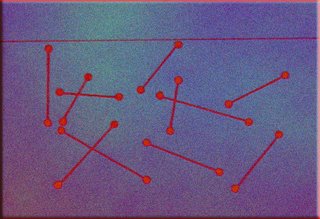
The many possible human relationships mentioned at the beginning of this chapter, would have to be depicted by a number of A-B lines in random directions, according to the respective position of each individual.
But if a particular individual (A) makes himself a neighbor to B as a demonstration of his love for God, the energy he thus creates must be depicted by a triangle.
If we also depict B's energy field by a triangle (that is, if in particular B, like this particular A, makes himself a neighbor as a demonstration of his love for God), the two triangles representing A and B will join harmoniously in a six-pointed star, with the center of each in congruence - representing the centrality of the concept "I am the Lord" in the life of each individual.
And if every individual were to replace the simple "I-thee" way of relating to the world (which relates in the near-chaos of figure 46) with the "I-thee-He" relationship, the human race would find a common center, and as a result, peace, joy, and welfare..
So we see that mutual centredness on the Lord can unify the entire race, but this by no means implies uniformity. Each individual would retain and express his own character. How different were, for example, the personalities of the three Patriarchs, or of Moses, David, Isaiah, and Amos; or of Hillel and Shammai; of Rabbi Akiva, Ibn Gavirol, Maimonides, the Ba'al Shem Tov, Rabbi A.Y. Hacohen Kook (or of King Cyrus, Emperor Ashoka, Guru Nanak, Gelal-u-din Rumi, Sant Kirpal Singh and Albert Schweitzer of the non-Jewish world), to mention only a very few of all those who focused their hearts on the One Lord.
Indeed, as each in his own way strives to attain an ever-closer likeness of the Lord, each can, and should, fully express a specific aspect of the infinite deity while leaving space for every other individual's expression, and without imposing upon anyone else's existence.
As a pious Rabbi, Susia said:"When finally before the throne of Divine Judgment, I will surely not be asked: Rabbi Susia, why have you not been Moses? Rather, I will be asked, Rabbi Susia, why havn't you been Rabbi Susia?"
Another famous saying which demonstrates our point is credited to Rabbi Hillel. When asked by a certain Gentile whether he could explain the essence of the entire Torah while standing on one leg, the rabbi answered: "Do not do unto others what is hateful unto you. The rest [of the Torah] is only commentary. Now go and learn [this commentary]!"
Indeed, we need to learn how to love properly in order not to do harm but to do good - be it in child care, in our marital relations, in helping the wounded, or on the spiritual path.
What is more, since many of the Torah's commandments concern the relationship between Man and God, it is obvious that Rabbi Hillel, in his answer to the Gentile, included them in the one which he paraphrased. This means that even those parts of the Torah which have to do only with the worship and glory of God are ultimately meant for the true physical and spiritual well-being of Humankind. The glory of God lies not in the death of the wicked, but in the well-being and peace of men.
This understanding is also expressed in the commandment: "Righteousness, righteousness shall you pursue." The question arises, why does the Scripture repeat the word righteousness? Rashi, an outstanding Jewish scholar of the Middle Ages, says in his commentary on the passage that a judge is thereby commanded to carefully weigh the merit in the arguments of both the claimant and the defendant. However, the ideal is neither to go to court, nor to be brought to court. We need have no fear of appearing before either a court of earthly judges or the Heavenly Court if we respect not only our own rights but also the rights of our neighbors. "Let your friend's honor and property be as dear to you as your own" is one of the sages' many instructions on the subject.
On the other hand, if billions of human beings pay mere lip service to the existence of the One God while actually remaining centered each on his or her own egotistical position, the triangles representing human relationships would look distorted, off-kilter or in opposition, for there would be no common, unifying center.
This off-centerdness is indeed the reason why even acts of supposed love - be it between man and woman, parents and children, neighbors, or political and religious groups - so often produce discord, quarrel and strife. Obviously, the healing lies in the proper understanding and practice of love.
The two equilateral triangles of the six-pointed star represent the ideal of harmony and peace between two different people (and between every "I" and every "thee").
Harmony and peace are achieved by focusing on God the Creator who alone can truly be called Love.
Let us in this context consider a slogan very much in vogue nowadays: “Make love, not war”. This idea, modern as it looks, traces in fact back to Alexander the Great. In an attempt to overcome the centuries old hostilities between Greece and Persia, he ordered his officers after Persia’s defeat to make love with, and even marry, daughters of the Persian nobility. Yet, this lovely idea of his did not work. Not only that most of the Persian ladies were not very fond of Greeks, quarrels broke out soon about such “daily problems” like heritage; who has a say; in what culture and fashion to lead one’s life; etc. Moreover, his huge empire fell apart immediately after his death, and the three evolving main claimants for rulership clashed one with the other. And the evolving Seleucid Empire clashed soon also with its Jewish subjects over the question “human liberties or Torah life” (and was defeated by the Hashmoneans).


Dr. Asher Eder's notes to this chapter:

In Hebrew, the word אהב, to love, commands an accusative case, as in other languages. However, in Lev.19:18 (and 19:34), it is not followed by the preposition את but by ל, the latter corresponding to a dative or sometimes genitive case. Thus, the most accurate literal translation of that term would be "and thou shalt love to thy neighbor", meaning thou shalt become a neighbor to the other one. The famous parable of the Samaritan in Luke 10:25 plays on this dative case.

Love of neighbor as a general attitude is in fact expressed by the Hebrew wording of that commandment. In ואהבת , ve'ahavta (usually rendered "and thou shalt love"), the ו , wav, stands not only for "and", but the whole passage is to be understood as: "If you behave in accordance with what you are told in Levit. chapter 19 verses 1-17, then thou wilt have loved thy neighbor as thyself, I am the Lord".
To behave in this way means that love of neighbor is a continuous process. In fact, it is an expression of constant God-consciousness. The Hebrew language expresses this by the ending ה, heh, in the word אהבה , ahavah, which could be interpreted as "oriented to love" (the ending ה, heh, can point out a direction). Also Eric Fromm, in his book the Art of Loving (Unwin Books, London, ISBN 0-04-157002-2), sees the love of neighbor as an attitude or orientation of character (see pp.38,46). Moreover, in gematria, the word כמוך = 86), , as thyself, equals the word God (אלהים = 86) from which we can also deduce the inner connection between the commandment to love God and the commandment to love our neighbor.

Cf. Job 42:10, where the term רע , rea, neighbor, is applied to Eliphaz the Temanite, Bildad the Shuhite, and Zophar the Naamthide, i.e. to members of other peoples. Likewise Ex.11:2, where this term is applied to the Egyptians. The Hebrew word רע can also be read ra, and would then mean bad, evil. Thus the phrase ואהבת לרעךwould allow also the following interpretations:
As beauty is in the eyes of the beholder, likewise the evil we are so apt to see in others is in fact within us (cf. Prov.27:19). It should be overcome by developing an attitude of that love as described in note 3.
If one comes against us as an enemy, and we remain in the attitude of love, we may hope to change the hostility into friendship (cf. Prov.16:7).

Interestingly enough, the numerical value of the verse "and thou shalt love thy neighbor as thyself, I am the Lord", which comes to 907, is the same as that of the verse "and thou halt love the Lord thy God" (907).
Moreover, the numerical value of the word אהבה , ahavah, love, is 13. Mutual love of neighbors renders a numerical value of 26 (2x13) which is also the numerical value of the Name of the Lord (5+6+5+10); i.e. in mutual love, the Lord is present. Of course, His love is always there; it wants to evoke our love of Him and His Creation. This is beautifully brought out by the gematria of the Jewish confession: יי אחד, Ad,onai ehad, the Lord (is) one. The numerical value of אחד, ehad, is 13, like that of love.
If we transcribe the term יי אחד into its numerical equivalents, it reads: 13 26. We could interpret this as "the Lord is love". This is one side of the coin, or one triangle of the hexagram, the other serving as a symbol for Man's love, which is required to form the hexagram, as a symbol of union in love.

The Hebrew word for righteousness, is closely related to zedekah, alms, mercy, charity. The word zedakah could also be translated "towards righteousness".

Thursday, November 09, 2006

Chinese Hexagram Lampshade


I just got this white Chinese Lampshade from China Town, New York. Iit has on its bottom a black hexagram surrounded by a black hexagon.

Good And Pleasant It Is For Brethern To Dwell

I already published on this blog a Star of David with a Cross, a Star of David with a swastika, and a Star of David with a Crescent, so in order to make this meeting of religious symbols more complete here's a Star of David with Om. 
Picture is courtesy of "ez2axs" from Flickr who wrote to me:

I took this photo in a suburban home of a friend's friend in Chennai, India. The friend's mother is an artist, sculptor and teacher who has travelled extensively in Asia and studied various Eastern and Western religions and philosophies. She does not believe in any religion, but believes in the power of light and human endeavor (as per a conversation we had on my only visit). She collects and makes lots of religious and culturally symbolic art and artifacts from her home.

Wednesday, November 08, 2006

The Divine Soul

The following paragraph is from Dr. Asher Eder’s book The Star of David, which was published in 1987 in English in Jerusalem by Rubin Mass Ltd. The publication here is courtesy of Oren Mass
The term 'breath of life' is not an adequate translation of the Hebrew ,נשמת חיים nishmat hayim, which designates the spiritual, or Divine soul. It is by breathing this nishmat hayim into him that Man becomes a living soul ( ,(נפש חיה nephesh haiyah.
Animals, too, breathe and are spoken of as living souls, but their souls derive from the earth which brought them forth. True, some of their actions resemble human behaviors, but this is due to the fact that the laws of the One Creator govern the whole universe. It has nothing to do with a nishmat hayim.
Here we should note that the word breathing (the breath of life) does not really convey the meaning of the Hebrew ,ויפח va'yipah, which describes the process of expanding, or extending something. The idea is to extend Man's soul, created in the Divine Image, into the realm of God's likeness; or, to use modern terminology, to elevate his consciousness above the limitations and restrictions of this world into the sphere of the Divine, the עולם הבא , ‘olam ha'ba, the coming world which is already there but is to come into our soul and consciousness. In terms of the Kabbalistic "Tree of Life", we could say the word va'yipah describes the expansion from the Sephirah ,יסוד Fundament, into the Sephiroth above the line נצח-הוד , Victory-Majesty. This, of course, is not a puffing up of the ego but its elevation into the higher reality of the Divine Presence.
Thus, the Scripture, by its speaking of Adam becoming a living soul through the breathing of life into him, makes two important points:
a) A man is considered a living soul, or spiritually alive, not by the fact of his physical breathing but through his being enlivened by the Divine breath. Of such living souls, it is said: "A candle of the Lord is the soul of Man". However, through the "First Adam", we all received a share of the Divine breath, or the Divine spark as it is often called.
b) Neither earth nor Man can generate ,נשמת חיים nishmat hayim. It is a gift of the Lord.
4) The account of the forming of Adam, and the breathing of the breath of life into him are close together. This means to say:
a) that these two acts together make (true) Adam. The form without the breath of life would be spiritually dead (dust from the earth), and the breath of life without the form would not be Adam either; it might be an angel, orרוח , ruah, i.e. spirit, or wind;
b) neither of these acts, forming or breathing, or their concomitant material and spiritual aspects, have any preference over the other.
While some schools of thought tend to treat the material aspect of nature, and of Man in particular, as inferior, dark and evil, Judaism sees it as an equal part of Creation, included in the statement "And God saw everything he made, and behold, it was very good".
Seeing these two aspects as equal does not mean that a harmonious balance between the spiritual and material can be brought about by compromising either. Our basic bodily drives should neither be suppressed nor eliminated, but neither should they rule us; rather, they should be directed and used for furthering the Divine purpose.
For instance, let us look at our daily meals to demonstrate this point. The biblical injunctions concerning clean and unclean food as well as the correct quantities of wholesome food are summed up in Prov. 30:8, which teaches us a proper supplication for it: "...provide me with lawful bread". We should enjoy our daily meals within the framework of the dietary laws and in the right proportion, being grateful for them as a Divine gift. 'He giveth food to all flesh, for His grace endureth forever', says Ps.136:25. We should ingest them with the intent to keep us healthy and fit for our mundane and Divine tasks. In Judaism, and in Kabbalah in particular, we would describe such an approach as elevating the mundane into the Divine. These aspects, the material and the spiritual, or mundane and Divine, if depicted by equilateral triangles, form the harmonious six-pointed star, or in terms of the Kabbalistic Tree, the upper and lower rhomb
Being descendants of the First Adam, we share that same pattern; it is our heritage and birthright. However, we are free to choose whether to take advantage of it or neglect it. As we can long for physical food and joy, likewise we can long for spiritual food and joy. And indeed, this longing is innate in every human being, although it is often misguided or covered up by all kinds of substitutes. Sayings like "Man does not live by bread alone, but by every word which comes from the mouth of the Lord", and "No bread - no Torah, no Torah - no bread", deal with these two equal needs of Man. That these aspects be seen as equal is indeed a pre-condition for Man's health. Any imbalance would cause tensions and consequently diseases in body and soul.

The Decalogue

The following paragraph is from Dr. Asher Eder’s book The Star of David, which was published in 1987 in English in Jerusalem by Rubin Mass Ltd. The publication here is courtesy of Oren Mass
In the Decalogue, we find a basic instruction on how to progress.
Given by the Lord, the Decalogue, a central part of the Torah, reflects again the underlying unity of Grace and Law . While it is well known that one tablet deals with the commandments between Man and God, and the second with those between Man and Man, we should also note that the Torah tells us about these two tablets: "on the one side and on the other side were they written". The one side reflects the strict order of law "not to make graven images", "not to kill", "not to steal", etc., while the other side reflects the grace by which the one who has been taken out from the house of bondage is guided by the Lord's spirit so that he "shall not make graven images", "shall not kill", "shall not steal", "shall not covet", etc.
In dealing with both law and grace, the Decalogue provides a clear instruction as to the right path. Grace can never contradict law. Rather, grace is a state of constant awareness of, and guidance by, the Divine presence. This idea is borne out by the very term Matan Torah. This Hebrew phrase does not speak of a one-time giving of the Torah in the distant past. It rather conveys the idea of a permanent giving of the Torah - a gift to be received by each generation anew.
We may now also understand why the Torah stresses that "The Lord is our God". We should not worship the forces of nature, including astrological charts, by considering them as ultimate truths; nor may we worship the gods and goddesses of fertility, nor brute physical force, nor the body as such by presuming that "in a healthy body would - automatically - dwell a healthy spirit", nor should we worship the more modern god of science as the 'ultimo ratio' which can answer all the needs of man.
To be sure, all these things contain some grain of truth. They are there to assist us, provided we have the right attitude. Yet adhering only to them would make them our masters, and we would stay 'undeveloped'. The Divine soul, ,נשמת חיים would remain retarded or wither away, leaving behind human husks in a state comparable to that of animals with some IQ.
Unfortunately, human history has provided ample evidence of this condition. However, the goal of Creation is Man in God's image and likeness, and not the 'animalization' of humans.
Numerous possibilities of development unfold in this process of man-making, This is partly due to free will on the part of Man which can be exercised within the framework of the natural and the spiritual laws governing Creation. Life itself, as well as the message contained in all the chapters following the record of Creation, show these possibilities vividly.
Thus, both the life of Adam and the structure of the Holy Scripture - which is in fact the Book of Man and his world - can be seen as complying with the Divine pattern outlined in the chapters "Meaning of the Triangles", and "Polarities".
The interwovenness of chapters I and II of Genesis and their meanings, i.e., the oneness of the material and spiritual aspects of our human nature, finds perfect expression in our star, whose two triangles may well stand for these two aspects.

I Shall be that I Shall Be

The following paragraph is from Dr. Asher Eder’s book The Star of David, which was published in 1987 in English in Jerusalem by Rubin Mass Ltd. The publication here is courtesy of Oren Mass

The process of forming Adam, and breathing life into him, is related to the term "Lord God". The addition of the term Lord to the term God should by no means be understood as the introduction of a new God besides Elohim of the first chapter of Genesis. It rather points to a specific and decisive aspect of one Creator: the aspect of mercy.
In order to understand this Divine aspect of mercy, let us consider the Hebrew word for Lord, i.e. the tetragrammaton which stands for this aspect. It cannot be pronounced, nor can it be translated, for it comprises everything which can be expressed in words as well as that which is beyond words. Moreover, its structure can be seen as an invocation of the past, present, and future tense of the Hebrew root word for BE. We humans are not able to pronounce these three aspects of time (or, indeed, entertain these three concepts) simultaneously, so how much less can we dare to pronounce the tetragrammaton? Instead, it is often referred to as "the Name" or "the Name of Names".
We find one of the most revealing interpretations of the meaning of the tetragrammaton in Ex.3:14, where, in accordance with the Divine plan, emphasis is placed on the future. God reveals himself to Moses with the words: "I shall be that I shall be".
This rendering of the Divine name in a future tense does not, of course, reduce the Lord's Divinity to a mere aspect of time. Time as such is not a force, and is therefore no deity at all. As forces may need a certain time span in which to operate, similarly the Lord apparently wants to take us, as individuals as well as collectively, through a time-bound process of education and growth, which would apply to our physical and spiritual natures.
This becomes clear in the verses and chapters following the revelation at the burning bush. These verses describe the exodus from Egypt, the receiving of the Torah at Mount Sinai, and the 40 years in the desert as a learning process, a preparation for entry into the Promised Land, the essential venue for implementing the Divine instruction. All this goes on under the aspect of Divine grace. In this way, Israel's history serves as a model for all Humankind; the Lord of Israel symbolizes the unifying of Man's will with the will of God, the Creator of all..
This process can be illustrated by applying the revelation ,אהיה אשר אהיה I shall be that I shall be, to both the Kabbalistic Tree and the six-pointed Star. Since we, being created in God's image, are to grow unto His likeness, we may infer that we are to become what we are by Divine will; and, vice versa, that the Lord God wishes His Divine qualities to be expressed to the fullest in Men.
This two-way process is indicated also by the wordאשר , asher, (rendered in the above revelation by the word that) as its basic meaning is to step forward, to progress. When we put this revelation on the Kabbalistic Tree, we would have to apply the two words אהיה , I shall be, to the upper and lower rhombs respectively, and the word ,אשר that, to the central and connecting Sephirah Splendor. When applying it to the six-pointed Star, we would have each of the two triangles representing the two words ,אהיה and the center representing the word אשר and what it conveys.