Monday, June 12, 2006

Joy and Magen David

Chuppa stone ritual, Nuremberg 1726 
From a book by P. S. Kirschner


Here's a copy of the letter I sent to Rabbi Reuven Lauffer at Ohr Somayach Yeshiva:
It seems that there's a deep connection between Joy and Magen David.
Recently I read about The Chuppa Stone beside the entrance of the old Freudental synagogue in Germany. On this Chuppa Stone the groom had to smash his glass of wine in memory of the destruction of the temple in Jerusalem.
I also read that researcher Falk Wiesemann found in Germany twenty-two such stones and on many of them there was engraved a Magen David.
On Wikipedia I read that many Ketubah designs incorporate religious or secular symbolism, such as the Magen David.
On your website I read that
Some people have the tradition to hanging a Magen David in their Sukka. Perhaps the six sides allude to the six "Ushpizen" guests who visit during the first six days of Sukkot: Avraham, Yitzchak, Ya'akov, Moshe, Aharon, and Yosef. The star as a unified whole symbolizes the seventh "Ushpizen" -- David -- the "king" who unifies the whole. Furthermore, the Magen David has 12 sides: David as king unified the 12 tribes.

IMHO the Magen David symbolizes Jerusalem (Zion) which is remembered by the Jewish people especially when they have the best reasons to rejoice… Sukkoth is a most joyful holiday, wedding is a most joyful event and yet - "If I forget thee, O Jerusalem, let my right hand forget her cunning" [Psalm 137:5[
Since I'm a secular Jew and since I'm not an expert on these matters I'd like to know how you comment on this theory.
The answer I got from the Rabbi was short but encouraging:
Sounds beautiful to me!
Best regards from Jerusalem,
Rabbi Reuven Lauffer

Sunday, June 11, 2006

Israeli Stamps

zion stamp magen David

stamp magen David


Israeli Stamps pictures with the star of David are courtesy of Dan Mahler from Hofesh Organization
Before the establishment of the state of Israel there were a few stamps that were issued by the Jewish National Fund in order to raise money. The first stamp was issued in 1902 and showed the Star of David surrounding the name Zion.
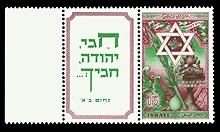
After the establishment of the state of Israel there were many stamps which showed the Star of David:
The above two Festival-of-Israel Stamps were designed by Arthur Szyk in 1950 and are showing the festival symbols of Sukkoth under the Star of David.
Ad Vanooijen, a Dutch artist, contributed a few designs over the past decade:
In 1980- "Magen David Adom Jubilee" series:
· "Blood Service"
· ''Mobile Intensive Care Unit''
In 2003 - The Flag series:
· Prague,15th Century
· Ness Ziona, 1891
· "Der Judenstaat" Herzl, 1896
· The State of Israel, 1948
In 1955 G. Hamori designed ''Twenty five years Magen David Adom''.
In 1968 Eliezer Weisshoff designed "Scouting ".
In 1972 M. Pereg designed ''Let my people go''.

Saturday, June 10, 2006

The Jewish Hammer

I just saw (and liked) Jonathan Kesselman's film, "The Hebrew Hammer," on my Cable TV. It's a slapstick about a Jewish private detective who saves Hanukah from an evil Santa Claus who wants to make everyone celebrate only Christmas.
The film parodies many common stereotypes about Jews but what attracted my attention was the extensive use of the Star of David to instantly characterize Judaism:
· On the Hammer's blue-and-white Cadillac hood.
· On the Cadillac's rear window.
· On the Cadillac's front door.
· On the Hammer's Belt.
· On the Hammer's spears.
· On the eye-patch of the chief of the Jewish Justice League.
· On the wall of the chief's office
· On the Israeli flag in the chief's office.
· On the entrance door to the Jewish Justice League building.
· On top of the device of the Jewish Atomic Clock.
· On the wall In the Hammer's mother's house.
· On the necklace of the Hammer's girlfriend.
…And I'm sure I missed a few others. It looks like a promotion film for Stars of David!
Another Jewish Hammer, a real one, is Jewish boxer Dmitriy Salita who goes by the name of “The Star of David” and wears a Magen David on his trucks.

Rastafarians

The Magen David is used to symbolize not only the Jewish religion but also the Rastafarian religion. It is used on a lot of reggae CD covers. The Rastafarians use the Magen David because they believe that their leader, the late King of Ethiopia Haile Selassie I was descendant from King Solomon and King David. (In Amharic Haile Selassie means "Power of Trinity". His former name was Ras Tafari Markonnen (1892-1975).


Friday, June 09, 2006

Mizrach decoration

 Mizrach decoration magen David

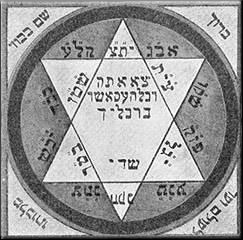
Star of David on a Mizrach decoration Image is copied from Jewish Encyclopedia (1901-1906)


The Mizrach  (Hebrew for east) is a decorative sign that Jews who lived in exile in the west hang on an eastern wall within their homes or their synagogues in order to remind them to face Jerusalem and the Temple Mount while praying (see: Talmud Berachot 30). This decoration includes usually the Hebrew word "Mizrach".

Basically this idea appears in the Israeli national anthem Hatikvah:


As long as the Jewish spirit is yearning deep in the heart,

With eyes turned toward the East, looking toward Zion,

Then our hope - the two-thousand-year-old hope - will not be lost:

To be a free people in our land,

The land of Zion and Jerusalem


Sometimes the Mizrach decoration includes a Star of David. IMHO this shows how strong is the connection between the concepts of "East" and "Zion" since the Star of David Symbolizes Zion.  

Yellow Badge

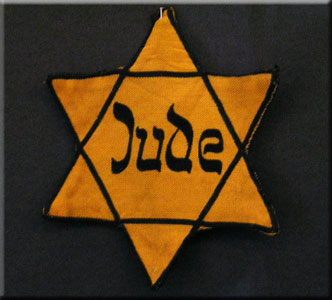
Yellow Badge
Photo courtesy of Daniel Ullrich, Threedots, who took it at the exhibition in the Jewish Museum Westphalia, Dorsten, Germany and put it on the Wikimedia Commons.
The following paragraph is from Dr. Asher Eder’s book The Star of David, which was published in 1987 in English in Jerusalem by Rubin Mass Ltd. The publication here is courtesy of Oren Mass
As part of its ferocious anti-Semitism, Nazi Germany tried to disparage the star, forcing its Jewish citizens to wear it as a yellow badge - the Judenstern (Jewish Star) as it was called.
It seems appropriate to mention here a poem written in 1942 in occupied Paris, after the Germans ordered the Jews to wear the yellow badge. The poem was written by a Russian Gentile, Elizabeth Skovzovah, who had emigrated to Paris after World War I. Working for the anti-Nazi underground, she was known as "Mother Mary". Her poem (translated from the Russian) follows:
SHIELD OF DAVID
Two triangles forming a star
Magen David—Shield of David
Shield of the Fathers—not a disgrace
A great gift—not a disaster.

Again they persecute you, Israel,
but what will the plots of Belial achieve
when in the lightning of the Sinai
God answers you again from above?

Therefore, awaken, you who have upon you the sign,
the Magen David, shield and symbol,
Learn to stand up in the battle of the generation
Against the sign of bondage, slavery and suffering.
However, not only Nazi-Germany denigrated the six-pointed star. In the Communist countries it was repressed, too, or it got disfigured where it could not be removed, as e.g. in the "Jewish House" at the Rumanian town of Czernovitz. There, all the two hundred hexagrams of its banister were disfigured during the Stalin era:

Thursday, June 08, 2006

Daughter of Zion

One of the terms that demonstrate that there's an identity between the Star of David and Zion is the "Daughter of Zion". Originally it refers to the Temple Mount which is the "daughter" of Mount Zion.

During World War I a poster for the recruitment to the Jewish Legion was published in American Jewish magazines. On it there was a big Star of David encircilng a woman (Daughter of Zion) and the words in Yiddish: "Daughter of Zion I want your Old New Land! Join the Jewish regiment. On the head of this Daughter of Zion there's a stripe with a small Star of David on its center. In this case Daughter of Zion represented the Jewish people.

 Daughter of Zion magen David