Wednesday, May 24, 2006

Our Sukkah Lampshade Poster

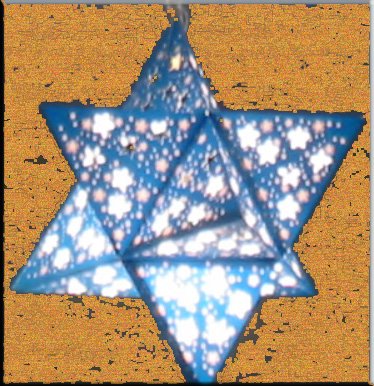
SUKKAH LAMPSHADE

Three Dimensional Star of David

Original design of Yevu-Yashir

The six sides of the Magen David symbolize the six Ushpizin

Abram, Isaac, Jacob, Moses, Aaron, Joseph

The Magen David in its entirety symbolizes the last Ushpizin – King David

Yevu-Yashir, Shimony 32/a` Jerusalem 97226785636 972522623345


Sukkah Lampshade New Model Blue

Sukkah Lampshade New Model Blue magen davidThis new model of our sukkah lampshade arrived yesterday. We hope that the shipment of the 3D folded paper sukkah lampshades will arrive here in time. Meanwhile we chose about 8 different colors.

I changed the "dull" realistic background with Photoshop. You can see the original and all the other models on http://www.flickr.com/photos/98026251@N00/

Sunday, May 21, 2006

The Tattoo Controversy

I already wrote about Star of David tattoos but since then I learned that this phenomenon is [1] growing and [2] becoming more and more controversial. People want to take part in the debate. Michael Lerner, 42, New York-born who made aliyah to Israel in 1985, has a Web site titled Tattoos are Not for Jews. Soon enough he got a letter from an angry opponent:

"Why should the Nazi's have been the last ones to make a statement regarding Jews and tattoos? I love my Star of David tattoo. It is much better than gold, which could be lost or stolen".

Marisa Carnesky, 32, is a British performance artist. She is heavily tattooed and pierced. She has a solo show titled Jewish Tattooess. 

So, my dear reader, where do you stand? Do you have a tattoo already? Is it in the shape of the Star of David; the shape that can tolerate two opposite sides of a hot argument without breaking down.

Marc Chagall


Star of David framing Hebrew letters in 
Marc Chagall's 
"The Pinch of Snuff" 1912

Source: 
wikipaintings.


Jewish artist Marc Chagall (1887-1985) came from a Hassidic family and that's why critics assume that paintings contain symbols such as the Star of David. In the Nazi period Chagall became a model of the "degenerate artist" and his
  "Most famous painting at the time, "The Pinch of Snuff," featuring a Rabbi and a Star of David, was dragged through the streets and exposed to public ridicule".
 In the Knesset (the Israeli parliament building) there's a hall, which is used for state receptions where Chagall designed a floor of mosaics. One of the main subjects described in this mosaic is the Star of David. It seems that this symbol is appreciated so highly that it enters naturally to the most distinguished and representational places in the country.
 The Knesset offers guided tours on Sundays and Thursdays between the hours of 8:30AM-2:30PM.
I hope to join one of these groups in the near future and take a picture of this work if it's allowed.

Messianic Shield

Nobody knows how the original Shield of David looked like in the past: It was never found in any dusty excavation; It was never painted or drawn by eyewitnesses. There isn't any written testimony about its look. All we have are modern versions about how it COULD HAVE BEEN LOOKED LIKE; for example the rectangular model Uri Ofir made for his exhibition titled MikraOr; or Arthur Szyk's lithograph entitled Israel (printed in 1949) in which we see Bar Kochba sitting next to a big blue Magen David holding in his hand a round shield with a yellow Star of David on a blue round background.

One of the theories about the origin of the Star of David is that during the Bar Kochba rebellion against the Romans in 70 C.E. a new technology was developed for shields so that behind the shield there were two interlocking triangles.

The translation of the Hebrew name Bar Kochba is the "son of the star". (His real name was Simon ben Cozeba, spelled also as Shimeon Bar Kosiba).

According to Jewish messianic expectations the Messiah is an offspring from the house of David. No wonder that in the past when a Messiah presented himself to the people he connected himself to the Shield of David. That was the case with Bar Kochba; that was the case with the Southern Iraqi Jew David Al Roy (aka Menachem Ben Shlomo), who started in the twelfth century a Jewish crusade aimed at conquering Israel by force of arms. That was the case with Shabbatai Zvi (1626-1676) who adopted the Magen David as his principle emblem.

The next Messiah will ride on a white donkey and I'm sure that in his hand there will be…a Shield of David.

Saturday, May 20, 2006

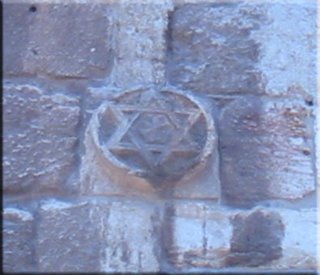
Guards On the Walls of Jerusalem

Solomon’s seal Jerusalem Walls 

In the past I read several times about Stars of David decorating the walls around the old city of Jerusalem. I even went to take a photo of the one that was supposed to be on the dung gate - but couldn't find it. Recently Rafi Kfir, lecturer and owner of the Ahavat Yerushalayim company, told me on the phone where are these Stars of David on the walls of Jerusalem. He told me about two places but I found a third one by myself. I enjoyed so much riding in the car slowly along the walls searching for these symbols...

 Anyhow I didn't know what's behind this phenomenon until I stumbled upon an article about Sultan Suleiman (1494-1566) the Magnificent who built these walls (1535-1538). 

It was Sultan Suleiman's messianic consciousness which led him to develop the link between himself and King Solomon. 

From the above excerpt readers may conclude that the Stars of David on the Walls of Jerusalem are not merely aesthetic Muslim decorations but that they are connected to the Jewish sources, to King Solomon.

Friday, May 19, 2006

Crystal Glass

Frankie Fox Jones, torch working crystal glass artist from Atlanta, Georgia, made some amazing Stars of David. She is a staff member of Frabel Galleries. In one of the three works I saw there is a Chai inside the Star and in another there's a Menorah. The height of each work is approximately twelve inches. The Stars of David Frankie Fox Jones created symbolize "strength and resilience of the Jewish people", hope and promise.

Hans Godo Frabel, who is one of the most influential glass artists in America, founded Frabel Galleries. He is famous for sculptures that make ordinary things look extraordinary.  Frankie Fox Jones surely walks in his footsteps.