Saturday, June 17, 2006
Mildenhall treasure
© Sheepdog Rex from Flickr
Protocols of the Elders of Zion
Friday, June 16, 2006
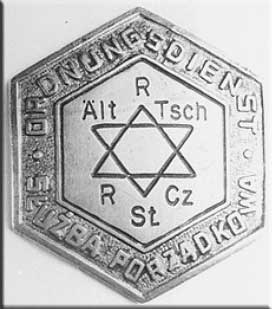
Jewish Police

Public domain photo from the United States Holocaust Memorial Museum
I saw this photo on Wikipedia and went to the source to find similar pictures, which were not Public domain, but supplied more info about this issue:
A Jewish border policeman stands by a guardhouse on a street corner in the Lodz ghetto, with a Star of David on his chest, 1940 – 1944.
A Jewish policeman helps two women move their belongings to new quarters in the Kovno ghetto. Under this picture I found an extensive explanation about the Kovno ghetto Jewish police force. The German created it in July 1941.
What is the Star of David Blook all about?
My future blook will be a book based on this blog. In this blog the last article pushes all the others downwards; the order is chronological and after a while it looks arbitrary. In my future blook the order will be by subject, exactly like in a book; it will be easier to follow it since it will be much more organized, even though the same micro contents will appear here and there. Let's say that this future blook will be a preparation for a paper printed version.
The cover of this blook will convey the idea that I'm writing it from a personal and intimate secular Jewish point of view and not from a scientific point of view. This will help me write nonchalantly without the burden and boredom of scientific discipline.
The first chapter will deal with the problem of definition: the Star of David has many shapes, meanings and names. In order to find out what are we talking about there's a need to check what it is not and then to try to deal with what's left. It is not an Arab or a Christian hexagram; it is not the hexagram used by alchemy or witchcraft or occultists or pagans or in astrology etc. It is the name of a shape which has a meaning. Only when these three elements, name shape and meaning, appear together in the same context we know that we are dealing with the Jewish Star of David.
The next chapter will deal with the countless meanings and interpretations of the Star of David: it symbolizes the future powers of the Messiah; the Ingathering of the Israelites; the encampment of the Tribes in the desert; the unity of all the possible opposites; it is the protector of the human spirit which is in the center of the six directions; it relates to six possible ways of contact that a Hebrew man has with the land of Israel; it alludes to the Sukkah Guests; it shows where the elements of the plate for the Seder evening have to be placed; etc.
The next chapter will deal with the numerous theories about the earliest usage of the Star of David:
Israelite slaves in Egypt crystallized salt with Stars of David made from straw (David Bloch's theory); it was created not by human hand and was used as an ornament in the Menorah Tabernacle (Uri Ofir's theory); King David's shield was built in this form; King Solomon used it in his ring; Kabalists started using it in the 14th century, Zionists started using it in the 19th century etc. An exciting side project is to examine whether the lost tribes used the Star of David while in exile. In this chapter there will be original excerpts from Aran Patinkin film about the lost tribes.
This chapter will make no effort to show who is right and who is wrong – it will just collect as many theories as possible so that readers who are interested in the truth will have an opportunity to find it.
The next chapter will deal with the many Judaica products that use the Star of David like jewelry, charms, books, lampshades, pottery, vase, neckwear etc. This section of the blook will collect mainly photos, some of them sent to me by other Star of David enthusiasts. It will show how diverse can the human imagination be. The same goes for different other usages of the Star of David like: amulets, advertisements, as a banknote security feature, as a form of a cookie, etc.
The following chapters will be dedicated to the Star of David as a symbol of (1) Judaism, (2) Zionism and (3) Israel.
The Star of David appears on Jewish Wedding Contracts and it is used in the Sukkah – two main sources of joy. My theory is that it is meant to remind the guests that the temple in Jerusalem is still destroyed and a Rabbi from Ohr Somayach commented that he liked this theory. The Star of David appears on book covers in order to identify immediately that we are dealing with Judaism or Zionism or Israel. There's an equation Star of David= Judaism (or Zionism or Israel) in tattoos, in works of art, in synagogue ornamentation etc. In a special chapter the blook will deal with this equation through the eyes of Nazis (yellow badge) and anti-Semites (cartoons).
The last chapter will be a bibliography. It will enable diligent readers to follow my journey or to make a blook of their own…
Thursday, June 15, 2006
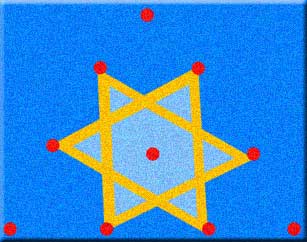
Tetraktys

Tetraktys is a mystical counting system graphically represented by a pyramid composed of dots arranged in rows. The Tetraktys of the number ten is made of ten dots arranged in four rows representing the numbers 1-4 (1+2+3+4=10)
This may help understand how the Seal of Solomon with the inscription of the Shield of David might have looked like.
Star of David Time Table
| Star of David Time Table |
| Israelite slaves in Egypt crystallized salt with Magen Davids made from straw (David Bloch's theory) Egypt 17 BCE |
| Magen David was created as an ornament in the Menorah Tabernacle (Uri Ofir's theory) Desert, 13 BCE |
| King David used it as his shield, Jerusalem, 10 BCE |
| King Solomon used it on his ring , Jerusalem, 10 BCE |
| On a wall of a room, Megiddo, 9 BCE |
| |
| On a seal belonging to Joshua b. Asayahu, Sidon, 7 BCE |
| The Ten lost tribes that were exiled by king of Assyria, 7 BCE |
| Kagome crest at some of Shinto's oldest and most important temples, Japan, 5 BCE |
| On Jar handles found by archeologist Sukenik, Israel, 1 BCE |
| It was the shape of Bar Kochba's Shield in his revolt against the Roman Empire, Israel, 2 CE |
| In a synagogue, Capernaum, 3 CE |
| On a Jewish tombstone, Taranto, 3 CE |
| On a Magic bowl found in 1853, Kinneret, 3 CE |
| On a rock excavated at a synagogue, Eshtamoa, 3 CE |
| In a Synagogue, Horbat Shura, 5 CE |
| Used by Khazars, Caucasus, 5 -10 CE |
| On a cover page of the Leningrad Codex, Leningrad, 11 CE |
| In a Synagogue, Hamelin, 13 CE |
| On a Tanakh manuscript, Toledo, 13 CE |
| On the flag of the Jewish community, Prague, 14 CE |
| On a flag of an allegorical figure in a Catalan manuscript, Catalonia, 14 CE |
| In a Kabbalistic book titled Sefer ha-Gevul, 14 CE |
| On a red flag when the Jews of Ofen received King Mathios Kuruvenus, Budapest, 15 CE |
| In the first Hebrew prayer book, Prague, 16 CE |
| On the walls of Jerusalem, 16 CE |
| As a trademark for Jewish printers, Europe, 16 CE |
| Isaac Luria taught that the elements of the plate for the Seder evening have to be placed in the order of the hexagram, Tzfat, 16 CE |
| On the tombstone of David Gans, the astronomer and historian, Prague, 17 CE |
| On a stone marking the boundary between the Jewish and the Christian quarters, Vienna, 17 CE |
| Used by Sabbatai Zvi, the false messiah, 17 CE |
| Rothschild incorporated it into his family coat of arms, Germany, 17 CE |
| On the Jewish community seal, Vienna, 17 CE |
| On a medallion and as part of the community's seal, Amsterdam, 17 CE |
| On wedding stones in synagogues, Germany, 17 CE |
| Alchemists began calling it the shield of David, Europe, 18 CE |
| Tombstone, Bordeaux, 18 CE |
| As a specific Jewish sign in a satirical anti-Semitic engraving, 18 CE |
| |
| Heinrich Heine signed his letters with a Magen David instead of his name, Paris, 19 CE |
| On the walls of a synagogue which was built from the remains of an ancient synagogue, Peki'in, 19 CE |
| The symbol of the first Zionist groups Bilu, Hovevei Zion etc. Europe, 19 CE |
| The Jewish Gauchos of the Pampas, Argentina, 19 CE |
| On the first edition of Herzl's newspaper Die Welt, 19 CE |
| Ephraim Moses Lilien's "From Ghetto to Zion" postcard, Bazel, 19 CE |
| On Edler von Lamel School building, Jerusalem, 20 CE |
| On a poster for the recruitment to the Jewish Legion, 20 CE |
| On the badge of the Zion Mule Corps soldiers, Turkey, 20 CE |
| Franz Rosenzweig wrote the Star of Redemption, 20 CE |
| On the old Technion building, Haifa, 20 CE |
| Yellow badges in the Holocaust, Europe, 20 CE |
| Jewish Autonomous Region in Russia, Birobidzhan , 20 CE |
| On Jewish Money, Ghetto Lodz , 20 CE |
| On the Israeli flag, Israel , 20 CE |
| Gershom Scholem wrote his prominent, research about the Star of David, Israel , 20 CE |