In the researches of Gershom Schlem, Gerbern Oegema, and other serious academic scholars artifacts are one of the main issues. They base much of their theories on the physical evidence found in the field. Archaeological excavations have top priority and every new dig can jeopardize the whole concept.
The main artifacts in the research of the Star of David are very problematic: who knows if the seal found in Sidon is really Jewish, or if the Star of David in the Capernaum synagogue is not Pagan or Christian. From an article by Uzi Dahari I gained another question mark about this prominence of Archaeological evidence:
How can we be sure that these are not FORGERIES?
Uzi Dahari wrote in his article titled "Archaeological Forgeries" :
While visiting the excavation at Ein-Gedi, conducted by my friend Professor Hirschfeld of the Hebrew University, I saw that he was very excited and told me that a unique talisman with Jewish symbols had just been found.. I looked at it and told him I am sure it is a forgery. There were no Star of David symbols in use as a Jewish symbol in the late Roman and early Byzantine era…
Saturday, June 17, 2006

Mildenhall treasure

Mildenhall Hexagram
Picture by
© Sheepdog Rex from Flickr
The Mildenhall treasure of Roman silver objects is exhibited in the British Museum. The treasure was discovered in 1943 in the small town Mildenhall, Suffolk, England. It was buried in the 4th century. On the center of a fluted silver bowl (Diameter: 40.8 cm) there is a Star of David. Researchers presume that the bowl was intended to hold water for washing hands at table.
Researchers say that it has no connection to Judaism.
My late mentor, Dr. Ze'ev Goldmann taught me to look at all the elements in each artifact, and here we see a six petaled flower inside the hexagon, and many more flowers between the points.
The six petaled flower inside the hexagon is a very common (floral) motif in Roman mosaics, but the flowers between the points seem unique.
M. Costa ["Hatakh ha-zahav, hotam Shelomoh u-magen-David", Poalim, 1990, Hebrew, pp. 160] wrote that identical Stars of David were found on four out of ten similar silver bowls in the Anglo-Saxon 7th century ship burial at Sutton Hoo, near Woodbridge, Suffolk , England. It was discovered
in 1939 and contained a wealth of artifacts.

Sutton Hoo Bowl with a Christian star of David
Photo Courtesy of © Sheepdog Rex from Flickr
In the central hexagon there's an 8 petaled flower
inside each triangle- a Fleur de Lys
Between the triangles - birds (Christian doves?)
and the star of David is in the center of a large Cross
made from 16 rhombs each of which is surrounded by a circle
Raziel the Angel

On The 13th century Book of Raziel the Angel pp. 77 (printed in Amsterdam in 1701) there are five
Magen Davids on one page, four of them with the name of god written in it. The context is: preparing kabalistic amulets. The book is written in Hebrew and in Aramaic.
Protocols of the Elders of Zion
Star of David appears on "Protocols of the Elders of Zion and their Biblical and Talmudic Origins 2003 by Ahmad Hijazi al-Saqa prof Comp Religion Al-Azhar".
On Google images there are more than 300 photos of the front cover of this book in various languages which can serve as an introductory album to anti-Semitism.
The Intelligence and Terrorism Information center the Center for Special Studies (C.S.S) published on January 2004 a Special Information Bulletin about the new Arabic edition of The Protocols of the Elders of Zion that was issued in Egypt in July 2002. On the front cover there's an illustration
"meant to depict the “Jewish world government” scheming to take over the world while looking for inspiration in Jewish religious books. In the foreground are two Jewish symbols, the seven-branched candelabrum and the Magen David (Star of David)".
The article brings photos of front covers from previous editions of The Protocols of the Elders of Zion which appeared in Egypt and on some of them there is a Star of David; like the one from the 1976 edition that shows a red Star of David encircling a monster and the one from the 1994 edition that shows a snake raising its head in the center of a red Star of David.
The Protocols of the Elders of Zion were a source of inspiration for Hitler
We read in Hitler's book. "In our times, the Jews' goal is a second revolution under the Star of David. When this book becomes well known to people, the Jewish danger can be considered overcome forever.
The Protocols were exposed as a forgery made for the Russian secret police in 1905 by Lucien Wolf in 1920, by Philip Graves, a correspondent for the London Times, in 1921 and by Herman Bernstein in 1935 – but hate and truth do not mix; they are like water and oil

Star of David appears on the front cover of
Los protocolos de los sabios se Sion
Argentinian edition

Another Star of David appears on the front cover of
Los protocolos de los sabios se Sion
Argentinian edition
Depicting the Jew as a beast

Another Star of David with swastika
appears on the front cover of
Los protocolos de los sabios se Sion
Argentinian edition

Another Star of David as a death sign
appears on the front cover of
Los protocolos de los sabios se Sion
Argentinian edition
Friday, June 16, 2006
Jewish Police
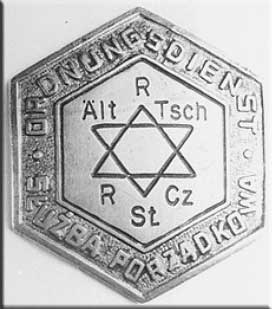
Public domain photo from the United States Holocaust Memorial Museum
I saw this photo on Wikipedia and went to the source to find similar pictures, which were not Public domain, but supplied more info about this issue:
A Jewish border policeman stands by a guardhouse on a street corner in the Lodz ghetto, with a Star of David on his chest, 1940 – 1944.
A Jewish policeman helps two women move their belongings to new quarters in the Kovno ghetto. Under this picture I found an extensive explanation about the Kovno ghetto Jewish police force. The German created it in July 1941.
What is the Star of David Blook all about?
My future blook will be a book based on this blog. In this blog the last article pushes all the others downwards; the order is chronological and after a while it looks arbitrary. In my future blook the order will be by subject, exactly like in a book; it will be easier to follow it since it will be much more organized, even though the same micro contents will appear here and there. Let's say that this future blook will be a preparation for a paper printed version.
The cover of this blook will convey the idea that I'm writing it from a personal and intimate secular Jewish point of view and not from a scientific point of view. This will help me write nonchalantly without the burden and boredom of scientific discipline.
The first chapter will deal with the problem of definition: the Star of David has many shapes, meanings and names. In order to find out what are we talking about there's a need to check what it is not and then to try to deal with what's left. It is not an Arab or a Christian hexagram; it is not the hexagram used by alchemy or witchcraft or occultists or pagans or in astrology etc. It is the name of a shape which has a meaning. Only when these three elements, name shape and meaning, appear together in the same context we know that we are dealing with the Jewish Star of David.
The next chapter will deal with the countless meanings and interpretations of the Star of David: it symbolizes the future powers of the Messiah; the Ingathering of the Israelites; the encampment of the Tribes in the desert; the unity of all the possible opposites; it is the protector of the human spirit which is in the center of the six directions; it relates to six possible ways of contact that a Hebrew man has with the land of Israel; it alludes to the Sukkah Guests; it shows where the elements of the plate for the Seder evening have to be placed; etc.
The next chapter will deal with the numerous theories about the earliest usage of the Star of David:
Israelite slaves in Egypt crystallized salt with Stars of David made from straw (David Bloch's theory); it was created not by human hand and was used as an ornament in the Menorah Tabernacle (Uri Ofir's theory); King David's shield was built in this form; King Solomon used it in his ring; Kabalists started using it in the 14th century, Zionists started using it in the 19th century etc. An exciting side project is to examine whether the lost tribes used the Star of David while in exile. In this chapter there will be original excerpts from Aran Patinkin film about the lost tribes.
This chapter will make no effort to show who is right and who is wrong – it will just collect as many theories as possible so that readers who are interested in the truth will have an opportunity to find it.
The next chapter will deal with the many Judaica products that use the Star of David like jewelry, charms, books, lampshades, pottery, vase, neckwear etc. This section of the blook will collect mainly photos, some of them sent to me by other Star of David enthusiasts. It will show how diverse can the human imagination be. The same goes for different other usages of the Star of David like: amulets, advertisements, as a banknote security feature, as a form of a cookie, etc.
The following chapters will be dedicated to the Star of David as a symbol of (1) Judaism, (2) Zionism and (3) Israel.
The Star of David appears on Jewish Wedding Contracts and it is used in the Sukkah – two main sources of joy. My theory is that it is meant to remind the guests that the temple in Jerusalem is still destroyed and a Rabbi from Ohr Somayach commented that he liked this theory. The Star of David appears on book covers in order to identify immediately that we are dealing with Judaism or Zionism or Israel. There's an equation Star of David= Judaism (or Zionism or Israel) in tattoos, in works of art, in synagogue ornamentation etc. In a special chapter the blook will deal with this equation through the eyes of Nazis (yellow badge) and anti-Semites (cartoons).
The last chapter will be a bibliography. It will enable diligent readers to follow my journey or to make a blook of their own…
Thursday, June 15, 2006
Tetraktys
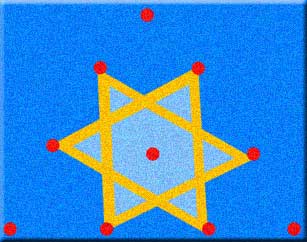
Tetraktys is a mystical counting system graphically represented by a pyramid composed of dots arranged in rows. The Tetraktys of the number ten is made of ten dots arranged in four rows representing the numbers 1-4 (1+2+3+4=10)
This may help understand how the Seal of Solomon with the inscription of the Shield of David might have looked like.
Subscribe to:
Posts (Atom)

